Marketing Automation Setup: The Six-Rung Revenue Ladder
Most Shopify operators in the $1M to $10M revenue band installed Klaviyo, switched on the welcome series, built a single abandoned cart flow, and stopped. Their dashboard says email contributes 22% of revenue. Flows contribute 18% of email.
11 min read · 3 February 2026
Marketing Automation Setup: The Six-Rung Revenue Ladder
Most Shopify operators in the $1M to $10M revenue band installed Klaviyo, switched on the welcome series, built a single abandoned cart flow, and stopped. Their dashboard says email contributes 22% of revenue. Flows contribute 18% of email. The team calls it "set up." That brand is leaving more than half of its automation revenue on the table.
The 18% Trap: Why Default Klaviyo Setups Cap at Half of What They Should Earn
Klaviyo's published benchmarks tell an uncomfortable story for any operator running default flows. The median abandoned cart flow converts 3.33% of recipients and earns $3.65 in revenue per recipient. The top decile of brands runs the same flow type and earns $28.89 per recipient at 7.69% conversion, per Klaviyo's abandoned cart benchmarks. Same flow name. Same software. Eight times the revenue.
That gap is not a software problem. It is an architecture problem.
The broader benchmark repeats the pattern across every triggered moment. Klaviyo reports flows generate roughly 41% of total email revenue from just 5.3% of total sends in their Klaviyo ecommerce benchmarks. Top-decile brands push that share to 25-45% from flows alone. Median brands sit at 15-20%. The gap is not creative. It is not deliverability. It is the difference between three or four fragmented flows and a real ladder of triggered moments.
Here is the operator pattern I see most often. A brand under $5M installs Klaviyo, enables the quick-start templates, edits the subject line, swaps in brand colours, and declares the work done. The welcome series fires on every newsletter signup with no segmentation gate. The abandoned cart sends one email twelve hours after add-to-cart. There is no browse abandonment, no checkout abandonment (which is distinct from cart abandonment), no post-purchase sequence beyond the order confirmation, and no win-back logic for a customer who has gone silent for ninety days.
The default install treats automation as a checkbox. The discipline that separates 15% flow revenue from 45% flow revenue is treating it as architecture.
There is another tell. When the team starts blaming "deliverability" or "list fatigue" for the missing revenue, the diagnosis is usually wrong. Brands sitting at 18% flow revenue have an architectural deficit, not a sender-reputation deficit. Adding rungs is the work. Cleaning the IP comes later, after the structural problem is fixed.
The Automation Revenue Ladder Framework
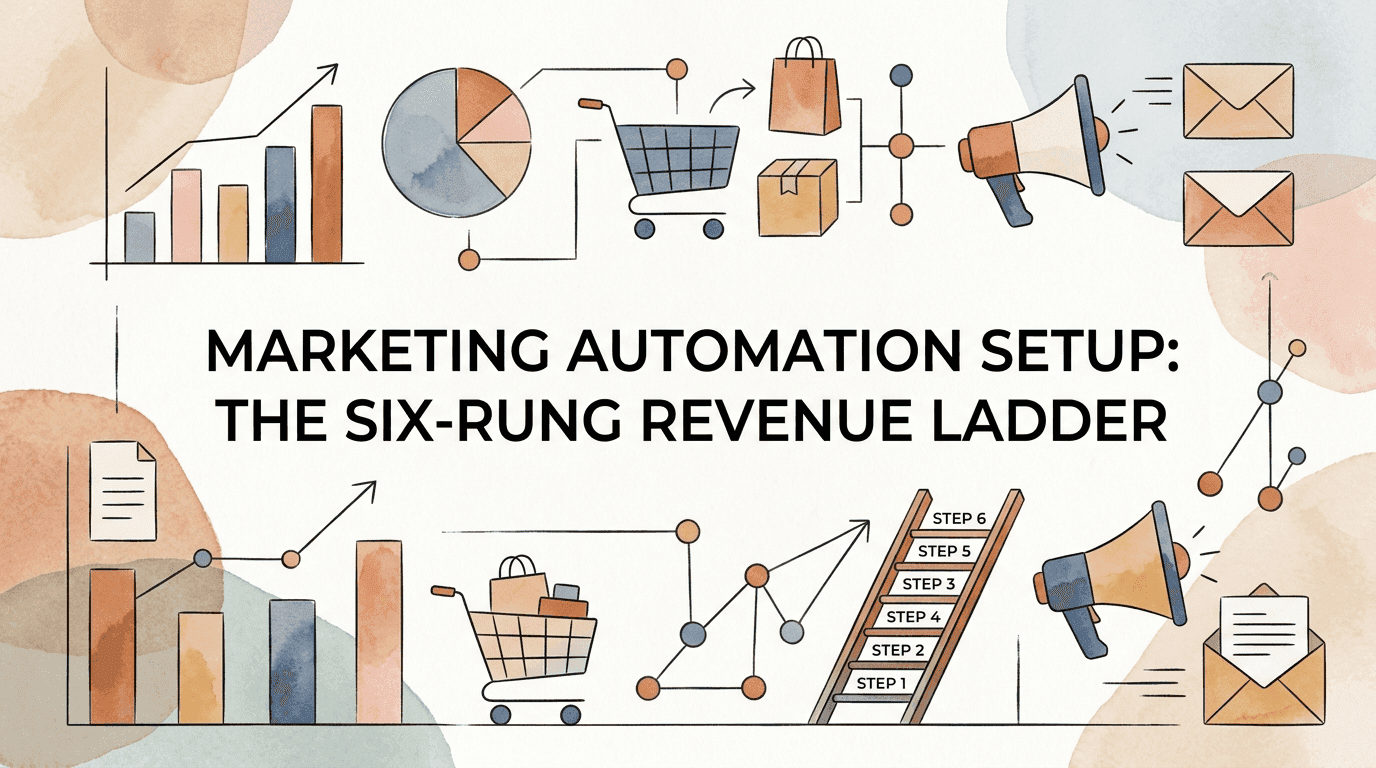
I call this The Automation Revenue Ladder Framework. It is a six-rung architecture where every triggered moment in the customer lifecycle has a defined job, a segmentation gate, and a revenue-per-recipient target derived from published benchmarks.
The six rungs are:
- Browse abandonment, triggered on category or product page view without add-to-cart
- Cart abandonment, triggered on add-to-cart without checkout start
- Checkout abandonment, triggered on checkout start without payment, a distinct trigger from cart with different intent
- Welcome, triggered on email signup, segmented by source
- Post-purchase, triggered on order placement, sequenced against shipping milestones
- Win-back, triggered on N-day silence, segmented by past purchase value
Each rung answers a different question. Browse asks "did the visitor see something they liked?" Cart asks "did they add it to the bag and stall?" Checkout asks "did they enter the funnel and abandon mid-flow?" Welcome onboards. Post-purchase confirms, educates, and primes the second order. Win-back catches lapsing customers before they churn fully.
The Ladder logic forces three rules every brand violates by default. First, no rung shares a recipient with another rung at the same moment, which means clean exclusion logic between flows. Second, every rung carries a segmentation gate, which usually means at least two branches per flow. Third, every rung has a named revenue-per-recipient target pulled from Klaviyo's benchmark library, so the team can measure each rung against a published bar instead of "more is better."
I have deployed The Automation Revenue Ladder Framework across dozens of physical product brands in the $1M to $10M revenue band. The brands that get to 35% flow revenue or higher are not the ones with the best copy. They are the ones with the most rungs operational, each with a real segmentation gate.
The Ladder is also why I push back on operators who blame deliverability or creative for missing flow revenue. A brand running three rungs at the median can rebuild the bottom of its email funnel by adding the missing three rungs before they touch a single subject line.
Phase 1: Install the Three Foundational Rungs (Days 1-30)
The first thirty days are about getting the bottom three rungs of The Automation Revenue Ladder Framework operational with proper segmentation. These three drive most of the revenue gap between default and architectural setups.
Rung 1: Cart Abandonment (Week 1)
A cart abandonment flow with a single email is malpractice. Klaviyo's data shows three-email cart sequences earn 6.5x the revenue of single-email flows. The architecture matters more than the copy.
Build the sequence with these triggers and gates: email one fires four hours after add-to-cart with a soft reminder and product imagery, email two fires twenty-four hours later with social proof and a friction-reducer (free shipping callout, return policy, or sizing help), email three fires seventy-two hours after with a small incentive, gated to first-time customers only. Returning customers do not need a discount to come back, and giving one trains them to wait.
The segmentation gate at this rung is purchase history. Never-purchased gets the discount path on email three. Repeat customers get a curated bundle nudge instead. This single gate is the difference between defending margin and torching it. CodeCrew's abandoned cart playbook shows the same structural pattern across the operators it audits.
The RPR target for this rung is $20 to $28, calibrated to the brand's average order value. Anything under $10 means the gate is missing, the timing is off, or both.
Rung 2: Welcome (Week 2)
The default welcome series treats every signup the same. The architectural welcome treats source as the primary segmentation gate. A signup from the homepage popup is not the same intent as a signup from a product-page exit-intent. A signup from a giveaway is barely qualified at all.
Build at least two welcome paths. High-intent (product page, exit intent, account creation) gets a four-email sequence introducing the brand, surfacing top sellers, and offering a small first-order incentive on email three. Low-intent (giveaway, generic popup, blog footer) gets a two-email education path with no incentive, designed to either qualify the contact or let them churn before they damage list health.
The gate at this rung is signup source plus engagement scoring after email two. Subscribers who open neither of the first two emails get suppressed from the rest of the path and routed to a quarterly re-engagement attempt.
The RPR target for the welcome rung sits between $4 and $8 for the high-intent path and $0.50 to $1.50 for the low-intent path. Setting one blanket target across both paths is exactly the mistake the default install makes.
Rung 3: Post-Purchase (Weeks 3-4)
The post-purchase rung is where most operators leave the most money. The default Klaviyo post-purchase flow sends an order confirmation and stops. The architectural post-purchase rung sequences against shipping milestones, primes the second order, and captures product reviews at the right moment.
Build the sequence with these timing anchors: email one is the order confirmation, email two fires on shipped status with delivery education, email three fires three days after delivery with a usage tip, email four fires fourteen days after delivery with a review request (gated to customers without a recent review), and email five fires forty-five days after delivery for replenishable categories or eight days after delivery for impulse categories with a curated next-order suggestion.
The segmentation gate at this rung is product category. A customer who bought a one-time-use product needs different timing than a customer who bought a sixty-day consumable. A customer who bought an apparel item gets a sizing-confirmation gate that a customer buying a coffee subscription does not.
The RPR target across the post-purchase rung is $1.50 to $3.00, but the real return is in the second-order rate lift, not the immediate per-recipient revenue. Measure both. A post-purchase rung that earns $2 per recipient and adds 8 percentage points to the 90-day repeat rate is worth far more than one that earns $4 per recipient with no repeat lift, because the repeat lift compounds across the customer's lifetime while the per-recipient revenue caps at the next order.
By the end of Day 30, the brand has three rungs operational with segmentation gates, RPR targets, and exclusion logic that prevents customers from receiving competing messages. Klaviyo publishes a flow audit checklist that doubles as a Day 30 verification step.
Phase 2: Add the Browse, Checkout, and Win-Back Rungs (Days 31-90)
The second sixty days are about layering on the discovery and recovery rungs. These three are where the architectural advantage compounds, because they capture revenue moments the foundational rungs structurally cannot reach. A brand that stops at Phase 1 has a working ladder; a brand that completes Phase 2 has a ladder that operates across the full customer lifecycle.
Rung 4: Browse Abandonment (Days 31-45)
Browse abandonment is one of the highest-impact rungs because it captures intent earlier in the funnel than cart. Klaviyo's browse abandonment guide reports browse flows convert at 0.96% on average, which sounds low until you compare it to the average campaign conversion rate near 0.10%. Browse abandonment converts roughly 9.6 times better than a generic broadcast, with an average $1.07 revenue per recipient.
Build the trigger on category or product detail page views without an add-to-cart event in the following hour. Email one fires two hours after the view with the specific product the customer browsed, email two fires twenty-four hours later with a complementary product or category page surface, email three fires forty-eight hours later (only for high-margin categories) with a soft bundling nudge.
The gate at this rung is engagement history. A customer who has browsed and never converted across thirty days needs different messaging than a customer who has converted twice in the last quarter. Skipping this gate produces noise, not revenue.
Rung 5: Checkout Abandonment (Days 46-60)
Checkout abandonment is distinct from cart abandonment, and operators who collapse them lose money. A customer who started checkout, entered an email, and abandoned at the shipping or payment step has a fundamentally different friction profile than a customer who added to cart on a category page and never proceeded.
Build the trigger on checkout-started without payment-completed within thirty minutes. Email one fires forty-five minutes later with a smooth resume-checkout link and a friction-reduction message (shipping cost reassurance, return policy, payment options). Email two fires twelve hours later with a customer service prompt for those who abandoned mid-flow.
The gate is the abandonment step. A shipping-step abandoner gets messaging about delivery options and timing. A payment-step abandoner gets messaging about Shop Pay, PayPal, or buy-now-pay-later. A coupon-failed abandoner gets a working code surfaced. Treating all three the same is a tax on conversion.
The RPR target for this rung sits at $5 to $10, lower than cart abandonment because the volume is smaller, but the conversion rate is typically 2-3x higher when the gates are right.
Rung 6: Win-Back (Days 61-90)
Win-back is the most under-built rung in the median Klaviyo install. The default approach is a "we miss you" email at ninety days, which earns near-zero. Klaviyo's winback email examples show the median win-back flow earns $0.84 per recipient for $100 to $200 AOV brands, but properly gated win-backs at the top end earn 4-6x that.
Build the trigger on N-days-since-last-purchase, where N is calibrated to the category's natural repurchase cycle. For replenishable categories like coffee or supplements, N is repurchase-cycle-plus-fifteen. For impulse categories like apparel, N is sixty to ninety. For high-consideration purchases like furniture, N is one hundred eighty.
Email one fires at N-days with a category-relevant nudge (no incentive). Email two fires fifteen days later with a small incentive gated to customers with two or more historical orders. Email three fires thirty days after that with a final outreach for customers above a defined LTV threshold, with a meaningful incentive. Below the LTV threshold, the customer is suppressed and routed to a quarterly re-engagement campaign instead.
The gates here are critical. A practitioner walkthrough at the BS&Co winback flow lays out the lapsed-window logic and AOV-based discount tiers in detail. The Ladder rule is that the win-back rung has the most aggressive segmentation gates of any rung, because the cost of incenting a low-LTV churner is higher than the lost revenue from letting them go.
By Day 90, the brand has all six rungs operational, each with named gates and RPR targets. This is the architectural baseline. From here, the work shifts to per-rung tuning rather than rung-counting.
The North Star: Flow Revenue as a Percentage of Total Email Revenue
The single metric that separates default installs from real architectures is flow revenue divided by total email revenue. The published median sits at 15-20%. The top decile sits at 35-45%. Klaviyo's flow benchmark library at the Klaviyo flow benchmarks confirms this gap is not a creative gap or a deliverability gap. It is an architectural gap.
Set the target at 35% as a working floor and 45% as the ceiling for any brand under $10M. Above 45%, you are usually leaning so hard on flows that broadcast quality is suffering, which catches up to you in deliverability scoring within two quarters.
Track the metric weekly. Track each rung's RPR against its benchmark monthly. The community thread at the Klaviyo benchmark report takeaways is a useful reference for calibrating per-rung targets to your specific AOV band, since the published averages mask significant variance between $50 AOV brands and $300 AOV brands.
Two follow-on disciplines convert this measurement into ongoing revenue. First, audit each rung quarterly against its RPR target and rework any rung sitting more than 30% below benchmark. Second, when adding a new rung beyond the six (a back-in-stock alert, a price-drop trigger, a VIP tier-up flow), give it a named RPR target before it goes live, never after.
The brand that started this article was running the default install at 18% flow revenue. Same Klaviyo account, same list, same products. After a Ladder build-out, that number sits at 38-42% within a quarter, with no change to ad spend, list size, or creative voice. The work is the architecture, not the copy.
For operators planning the next layer of work, the upstream cleanup that makes The Automation Revenue Ladder Framework run properly is your CRM-to-Shopify wiring (covered in the CRM connection patterns article) and your broader email sending stack (covered in the email sending stack article). A Ladder built on a broken customer object is just faster waste.
The discipline is not the copy. The discipline is the rungs. Build the architecture first, name the gates, set the per-rung RPR targets, and the revenue follows. Skip the architecture and the best subject lines in the world will still cap your flow share at 18%.
Unit Economics Calculator
Contribution margin per order after COGS, shipping and fees — the number scaling actually depends on.
Cart Abandonment Solutions That Recover 25% of Lost Carts
Your Email Automation Is Stuck on Welcome Flows - Here's the Full Lifecycle System
Email Marketing Best Practices for Shopify Stores
Loyalty Program Wiring: The Four Sync Layers
AI Email Marketing Optimization Tuned to Revenue, Not Opens
Customer Churn Analysis Template That Actually Works
Newsletter
The Uncommon Insights Letter
Practical FMCG & eCommerce growth playbooks — margins, retention and scaling tactics, straight to your inbox.
Turn shopify tech stack into profit you can see
Get a hands-on operator to turn the frameworks above into results — book a free audit call.