AI Email Marketing Optimization Tuned to Revenue, Not Opens
Klaviyo's Smart Send Time and AI subject-line generator are the two features brand operators reach for first when they hear the words AI email marketing. They are the easiest features to switch on. They produce the cleanest before-and-after chart on open rate.
9 min read · 10 March 2026
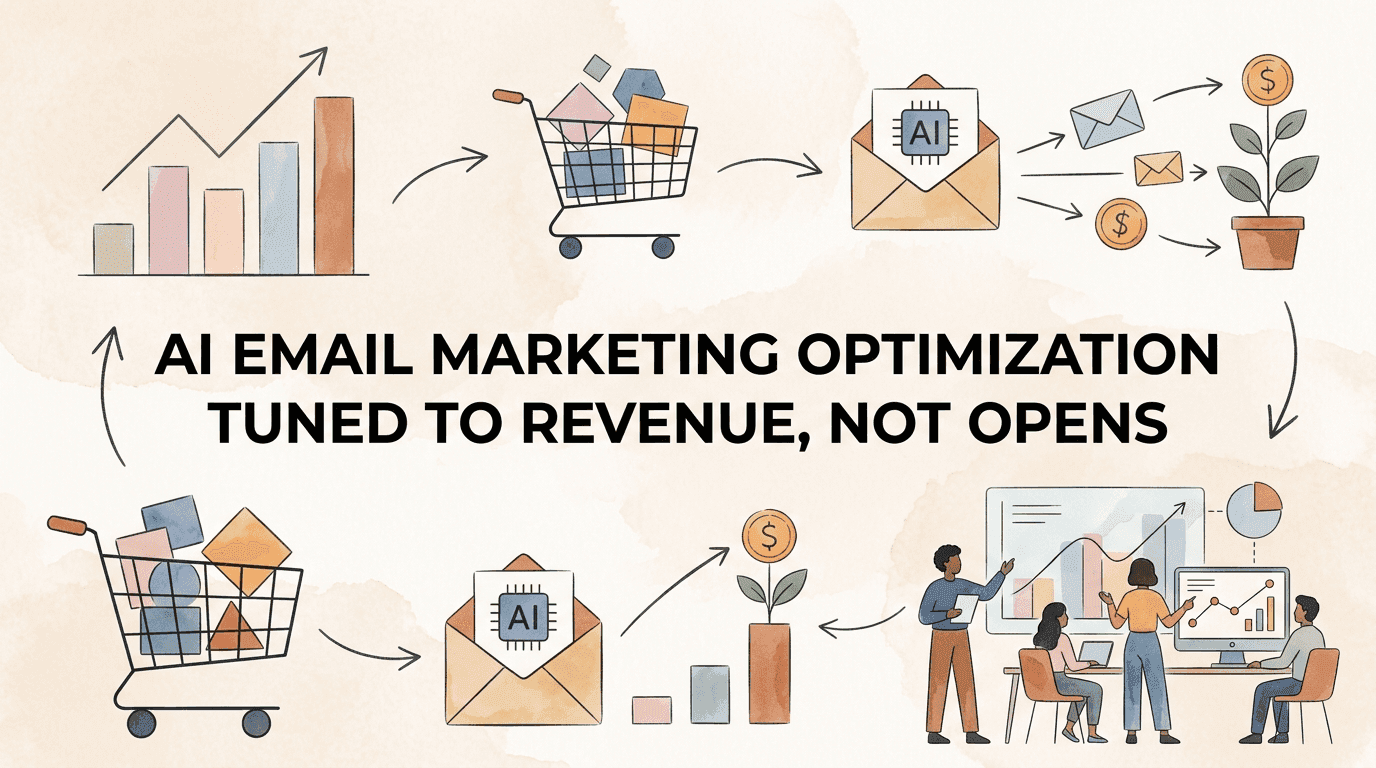
AI Email Marketing Optimization Tuned to Revenue, Not Opens
Klaviyo's Smart Send Time and AI subject-line generator are the two features brand operators reach for first when they hear the words AI email marketing. They are the easiest features to switch on. They produce the cleanest before-and-after chart on open rate. The chart goes up. The team congratulates itself. The CFO asks why revenue per recipient is flat or down, and nobody has a good answer.
The reason nobody has a good answer is that the tuning target was wrong. Open rate has been a structurally noisy metric since Apple Mail Privacy Protection shipped in iOS 15. The AI features are not lying. They are tuning to a number Klaviyo itself describes as inflated. The fix is not to disable the AI. The fix is to rebind the objective function from open rate to revenue per recipient and rebuild the ruleset on the metric that actually pays for the platform.
The Open-Rate Mirage Klaviyo's Own Documentation Calls Out
Apple Mail Privacy Protection silently inflates reported open rates by prefetching tracking pixels for every Apple Mail user whether or not the message was actually opened. Klaviyo Apple MPP smart send is explicit on the mechanism. Klaviyo's community guidance flags that a Smart-Send-Time configuration tuned to maximise opens is tuning to a metric Klaviyo itself describes as inflated. The platform documents the problem and ships the feature on the inflated metric anyway, because that is what most operators ask for.
The cohort breakdown makes the inflation worse, not better. An ecommerce list with a heavy iOS share, which most DTC brands have, will report open rates between 45 and 65 percent on flow messages. That number is not engagement. That number is Apple's privacy proxy firing pixels on messages that were never read. The Smart Send Time recommendation engine reads those firings as engagement signal and tunes the send window to the time of day Apple's proxies happen to fire most often, which is correlated with delivery time more than with actual open behaviour.
The downstream effect on revenue is silent and ugly. The send window shifts to the algorithmic sweet spot for proxy fires. The actual engaged readers, the ones who genuinely open and click, see the message at a time that does not match their behaviour. Click rate softens. Revenue per recipient softens with it. The dashboard shows open rate up, RPR flat, and the team chalks the RPR softness up to seasonality or list fatigue. The honest read is that the engine optimised for the inflated metric and pushed the campaign off the window that genuinely engaged readers respond to.
Klaviyo deliverability metrics lists the honest engagement signals. Click rate, conversion rate, and revenue per recipient are the metrics Klaviyo itself calls reliable post-MPP. Open rate is on the same page, with explicit caveats about the inflation. The brands that read past the open-rate column are the brands that catch this before it costs them a quarter of campaign performance.
Klaviyo email benchmarks 2026 publishes the cross-vertical numbers operators should be reading. The benchmark page leads with revenue per recipient, click rate, and conversion rate by industry. Open rate is on the page. It is not the headline. The platform's own benchmark publication is structured to discourage the open-rate-first reading that the AI feature defaults to. The disconnect between Klaviyo's published guidance and Klaviyo's default AI configuration is the gap operators have to close on their own.
You might think the AI subject-line generator is exempt from this trap. It is not. The subject-line tool optimises against the same engagement signal Klaviyo's account telemetry exposes, which means it inherits the open-rate noise. A subject line that wins on AI ranking can lose on click rate and revenue per recipient because the model rewarded a phrasing that triggers proxy fires without earning a read.
The Send-Time Intelligence Engine
I call the fix The Send-Time Intelligence Engine. The name is a deliberate inversion. The default configuration sells itself as send-time intelligence. It is send-time inference based on a noisy metric. The replacement keeps the AI features on, but reads them through the only objective that pays the bills: revenue per recipient by cohort, sustained over a 30-day window, with click rate as the supporting honest engagement signal.
The engine has three operating principles. First, every AI feature in the account, Smart Send Time, subject-line generator, predictive segmentation, gets judged on revenue per recipient by cohort, not on open rate. Second, the cohort splits matter as much as the metric. RPR for the engaged-30-day cohort behaves differently from RPR for the engaged-90-day cohort, which behaves differently again from the lapsed-180-day cohort. A single account-wide RPR number hides where the engine is winning and where it is losing. Third, the dashboard is rebuilt to show the honest metric stack first. Open rate is moved to a secondary panel with an MPP-inflation caveat. RPR by cohort and click rate by cohort lead the page.
I have walked this engine through stacks that were running 8-figure annual email programs. The pattern at the start of the rebuild is consistent. Open rate is reported at 50 to 60 percent. Click rate is reported at 1.5 to 2.5 percent. RPR sits between $0.20 and $0.45 per send. The team is pleased with open rate, frustrated by RPR, and cannot reconcile the two because the cohort breakdown does not exist in the dashboard.
The rebuild reverses the order of operations. The engine starts with the RPR target, segments the list by cohort and engagement window, and back-solves the AI rules to the cohort that is producing or destroying the dollar number. Klaviyo flow analytics exposes the message-level RPR and conversion telemetry the engine needs. The capability is in the platform. The discipline of reading it instead of the open-rate column is the work.
Klaviyo email benchmarks UK reports RPR ranges that give operators a credible external benchmark for the cohort-level rebuild. The Send-Time Intelligence Engine treats those benchmarks as the floor, not the ceiling. A brand running cohort-level RPR tuning should be aiming meaningfully above the cross-vertical average within two quarters.
Phase 1: The Objective-Function Audit (Days 1-30)
Day 1 is not a strategy meeting. It is a feature audit. Open the Klaviyo account and list every AI-driven feature in use: Smart Send Time on flows, Smart Send Time on campaigns, AI subject-line generator, predictive churn segmentation, predictive CLV segmentation, AI-powered content blocks. For each feature, document what metric it is currently being judged on, what cohort split is in place, and who owns the configuration.
Klaviyo smart send time describes the math behind the Smart Send Time recommendation. The mechanic is a per-recipient model that reads historical engagement to predict the best send window. The default engagement signal is open-time. The audit's job is to flag every feature where open-rate is the implicit target, then queue the replacement objective.
Build a spreadsheet with seven columns: Feature, Current Objective, Cohort Split, Owner, RPR-Aware (Y/N), Click-Aware (Y/N), Replacement Objective. The Replacement Objective column drives the rebuild. For Smart Send Time, the replacement is RPR by engagement cohort. For the subject-line generator, the replacement is click-through to RPR ratio. For predictive segmentation, the replacement is segment-level RPR delta against a holdout.
Week 2 and Week 3 are the dashboard rewrite. Most operator dashboards lead with open rate because Klaviyo's default reporting view leads with open rate. Pull the dashboard apart and rebuild it with RPR by cohort as the headline. Move open rate to a secondary panel with an MPP-inflation caveat written next to the number. Peasy Klaviyo metrics is a useful operator reference for separating the vanity metrics from the revenue metrics, and it shows the cohort-level cuts that should appear in the new dashboard.
Week 4 is the holdout configuration. Every AI feature in the rebuild needs a holdout cell, which is a 10 percent random sample of the audience that continues to receive the legacy configuration. Without the holdout, the brand cannot read incremental RPR lift. With the holdout, every weekly review shows the AI cell against the legacy cell on the metric that pays the platform. Klaviyo AB testing guide covers the AB-test mechanics inside Klaviyo and is the practitioner reference for setting up the holdout cleanly.
Phase 2: The RPR-Optimized Flow Rebuild (Month 2-6)
Month 2 starts with the highest-volume flow, which is almost always the welcome series or the abandoned-cart sequence. Rebuild the flow with RPR as the primary KPI per message, segmented by engaged-30-day, engaged-90-day, and engaged-180-day cohorts. The cohort split usually surfaces a counter-intuitive result inside the first measurement window: the engaged-30-day cohort responds to a tighter send cadence with longer subject lines, while the engaged-180-day cohort responds to a looser cadence with shorter subject lines. The single-rule version of the flow forces both cohorts onto the average, which is exactly why RPR has been flat.
Month 3 is the campaign-side rebuild. Smart Send Time gets retuned with click rate as the engagement signal instead of open rate, which Klaviyo supports as a configurable input on the campaign-send setup. The subject-line generator gets paired with a manual A/B test on RPR for the first eight campaigns, so the operator team can read the model's outputs against the dollar metric and override anything that looks click-baited rather than revenue-driven.
Month 4 to Month 6 is the cadence and list-health pass. RPR softens fastest when send frequency outruns the cohort's appetite. The Send-Time Intelligence Engine treats list health as a primary input, not a hygiene afterthought. Engaged-30-day cohorts can absorb three to five sends per week. Engaged-90-day cohorts cap at two to three. Engaged-180-day cohorts cap at one a fortnight, with anything above that pushing the cohort into deliverability damage that hits RPR account-wide. The cadence rules get encoded into Klaviyo's flow filters and campaign sending rules so the cohort caps run automatically.
The dashboard discipline tightens through Phase 2. Every Monday review reads RPR by cohort against the holdout, click rate by cohort, conversion rate by cohort, and revenue per send for the campaigns. Open rate is on the page with the inflation caveat next to it. The team is allowed to look at open rate for diagnostic purposes. The team is not allowed to celebrate open rate as a win.
The Metric That Replaces Open Rate
Stop reading email program performance through open rate. Open rate is a structurally noisy metric, and the AI features tuned to it produce a healthy chart that does not translate to dollars. The metric that proves The Send-Time Intelligence Engine is working is revenue per recipient by cohort, sustained across at least two consecutive 30-day measurement windows, with click rate as the supporting honest engagement signal.
The brands that complete this rebuild end up with a flat or marginally lower account-level open rate, a click rate up by 15 to 30 percent on the cohort-aware flows, and an RPR up by 20 to 40 percent against the legacy holdout. The open-rate softness is the MPP inflation falling out of the metric. The click rate and RPR lift is the engine finally being paid for the work it was bought to do.
The Send-Time Intelligence Engine does not replace Klaviyo's AI features. It replaces the objective the AI features are pointed at. Smart Send Time still ships. The subject-line generator still ships. Predictive segmentation still ships. What changes is that every one of them is judged weekly on a dollar metric against a holdout, and the team is no longer allowed to take credit for an open-rate chart that finance cannot read in the P&L. That is how an AI email program earns its subscription cost, and it is the only configuration of the platform that survives a serious cost-of-capital review at renewal time.
One last note for the team running this rebuild. The vendor's quarterly business review will lead with open rate because that is the metric the platform's default reporting view promotes. Do not argue with the vendor's slide deck. Bring your own one-page summary with RPR by cohort against the holdout, click rate by cohort, and the dollar lift over the legacy configuration. Walk the vendor through the cohort-level cuts. The conversation, repeated quarterly, is what keeps the platform honest and what gives the brand the data to renegotiate the contract from a position of strength rather than from a position of inherited assumptions.
Unit Economics Calculator
Contribution margin per order after COGS, shipping and fees — the number scaling actually depends on.
An AI Driven Personalization Framework That Actually Lifts Margin
Predictive Analytics for Customer Behavior That Earns Its Cost
Marketing Automation Setup: The Six-Rung Revenue Ladder
AI Customer Segmentation Beyond The Default RFM Buckets
A Chatbot Implementation Guide That Protects Conversion Rate
Analytics Reporting Stack Setup: Decisions Over Dashboards
Newsletter
The Uncommon Insights Letter
Practical FMCG & eCommerce growth playbooks — margins, retention and scaling tactics, straight to your inbox.
Turn ai optimization into profit you can see
Get a hands-on operator to turn the frameworks above into results — book a free audit call.