Cookie Deprecation Impact Solutions That Actually Work
Most ecommerce operators spent 2023 and 2024 bracing for a single event: the moment Google would finally kill third-party cookies in Chrome. Entire marketing teams built contingency plans around a deadline that kept shifting.
9 min read · 5 February 2026
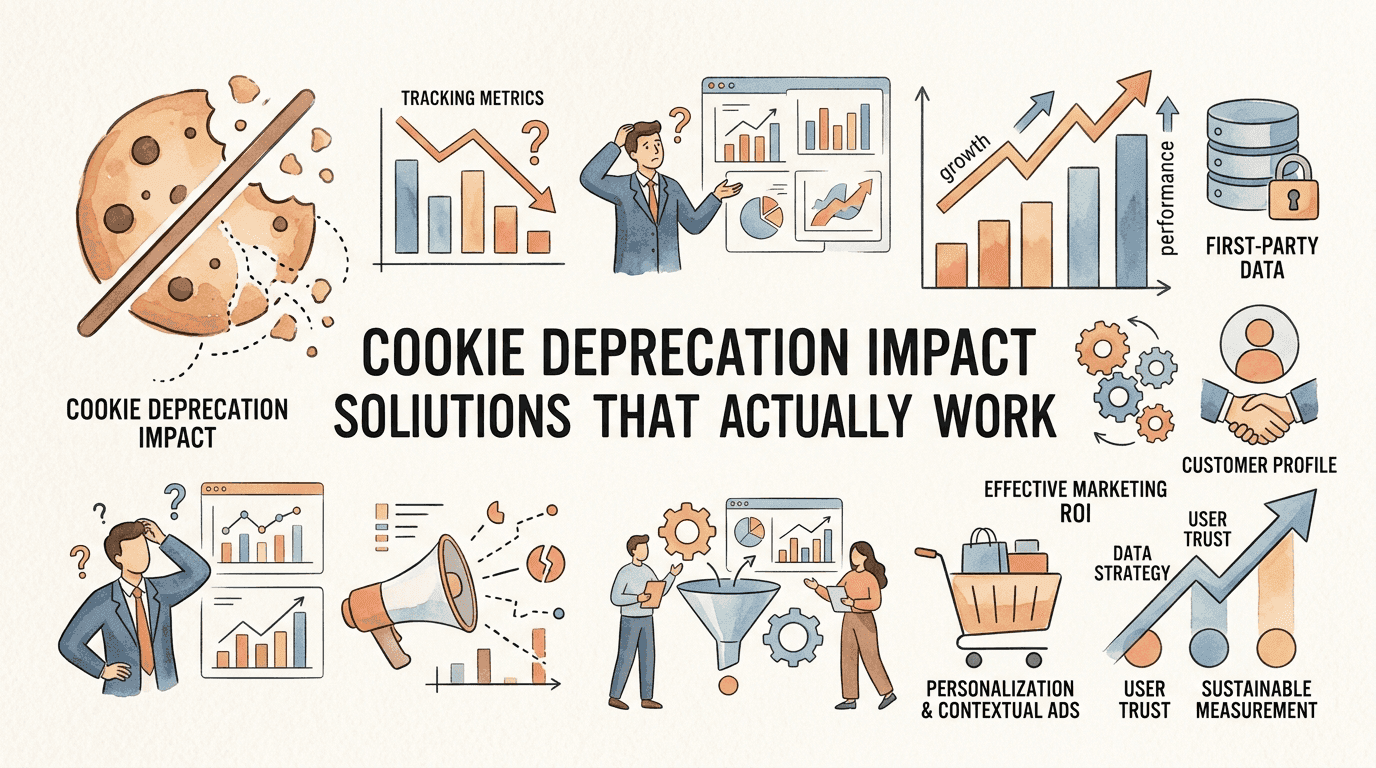
Cookie Deprecation Impact Solutions That Actually Work
Most ecommerce operators spent 2023 and 2024 bracing for a single event: the moment Google would finally kill third-party cookies in Chrome. Entire marketing teams built contingency plans around a deadline that kept shifting. Budget was allocated for consultants, new tools, and cookie-alternative pilots. And then Google backed down, again, in mid-2024.
Here is the part nobody talks about: while everyone watched Chrome, Safari and Firefox had already killed third-party cookies. Safari did it in 2020 with ITP. Firefox followed with Enhanced Tracking Protection. Together, those two browsers represent 30-40% of web traffic for most ecommerce stores. That means the catastrophe everyone feared already happened, quietly, on a significant chunk of your traffic. Marketers are potentially missing 40-60% of conversions because browser restrictions, consent requirements, and privacy tools block traditional tracking pixels right now, today.
You are not preparing for a future crisis. You are operating inside one.
Your Attribution Dashboard Has Been Lying Since 2020
The standard ecommerce measurement setup still looks something like this: Meta Pixel fires on page load, Google Ads conversion tag fires on purchase, Google Analytics 4 collects session data, and a last-click or data-driven model assigns credit. Every piece of that chain depends on the browser accepting and passing third-party cookies.
On Safari and Firefox, that chain has been broken for years. What happens when the pixel fires but the browser blocks the cookie? The click still registers, but the conversion cannot be matched back to the original ad interaction. The result is a quiet, systematic under-reporting of conversions on non-Chrome browsers.
This creates two specific distortions in your data. First, retargeting audiences shrink because you cannot build cookie-based audiences from Safari and Firefox visitors. If 35% of your traffic comes from those browsers, your retargeting pool is already a third smaller than your ad platform reports. Second, cross-site journey tracking breaks entirely. A customer who clicks a Meta ad on their iPhone (Safari), browses your store, leaves, and returns through a Google search two days later looks like two separate visitors. That upper-funnel Meta click gets zero credit.
The downstream damage is real. Brands running $50,000 or more per month in ad spend are making decisions on incomplete data. Google branded search gets over-credited because it is the last click that still tracks reliably. Prospecting channels like Meta, TikTok, and YouTube get under-credited because they drive the initial awareness touch that cookies can no longer connect to the final purchase.
I have seen this pattern across dozens of brands in the $1M-$10M range. They look at their attribution dashboard, see Google branded search delivering a 6:1 ROAS, and conclude that is where the money should go. They cut upper-funnel spend, branded search volume drops three weeks later, and they cannot figure out why.
The cookie did not just deprecate. It degraded, slowly, starting in 2020. And the brands that did not notice are now making million-dollar decisions on a data set that represents 60% of reality at best.
The Post-Cookie Measurement Stack
The Post-Cookie Measurement Stack is a three-pillar model that replaces cookie-dependent attribution with infrastructure that works regardless of browser, device, or consent status. I have deployed versions of this across fourteen ecommerce brands in the last two years, and the consistent finding is that operators recover 25-40% of previously invisible conversions within the first 60 days.
The three pillars work in sequence:
Pillar 1: Server-Side Capture. Move your tracking from the browser to your server. Instead of relying on a JavaScript pixel that the browser can block, you send conversion data directly from your server to Meta, Google, and other platforms via their server-side APIs. The browser never gets a chance to interfere. This is the foundation. Without it, Pillars 2 and 3 have incomplete data to work with.
Pillar 2: Aggregated Measurement Models. Layer privacy-safe aggregated methods on top of server-side data. This includes platform-native tools like Meta's Aggregated Event Measurement and Google's Enhanced Conversions, plus media mix modeling for brands spending enough to generate statistically significant channel-level data. These models do not track individuals. They measure channel-level lift, which is what you actually need for budget allocation.
Pillar 3: Deterministic Matching. Build a first-party identity layer through authenticated user experiences. When a customer logs in, subscribes, or creates an account, you create a first-party data connection that persists across sessions, devices, and browsers. No cookie required. This is the long-term play that turns your customer base into your measurement infrastructure.
The stack does not require you to predict what Google, Apple, or any browser vendor will do next. It works today because it bypasses the browser entirely for critical measurement events.
Phase 1: Server-Side Migration and Data Recovery (Days 1-30)
Start with Pillar 1. This is where you recover the most lost visibility in the shortest time.
Days 1-7: Audit your current tracking gaps. Pull your GA4 data and segment conversions by browser. Compare Chrome conversion rates to Safari and Firefox conversion rates. If you see a 20%+ gap in conversion rate between Chrome and non-Chrome traffic, that gap is not a real behavioral difference. It is a measurement gap. Your Safari visitors are converting; your tracking just cannot see it.
Next, check your Meta Events Manager for event match quality scores. If your purchase event match quality is below 6.0, you are leaving significant data on the table. Google Ads has a similar diagnostic in the conversion action settings showing modeled conversions as a percentage of total.
Days 8-21: Deploy server-side tracking. For Shopify brands, this means implementing Meta's Conversions API and Google's Enhanced Conversions through server-side tag management. Shopify's native CAPI connection is a starting point, but dedicated tools like Elevar, Stape, or server-side Google Tag Manager give you more control over event deduplication and parameter passing.
The critical setup details: configure event deduplication so you are not double-counting conversions that fire from both the browser pixel and the server. Set up server-side event matching using email address, phone number, and external ID parameters. The more identifiers you pass, the higher your match rate.
Days 22-30: Validate and baseline. Run a two-week comparison period. Track total reported conversions before and after server-side deployment. Most brands see a 15-30% increase in reported conversions from Meta alone, not because they got more sales, but because they are finally seeing the sales that were already happening.
Document this baseline. You will need it for Phase 2 calibration and for proving ROI to your team or board.
Your marketing manager or operations lead should own this phase. Budget roughly $200-$500/month for server-side infrastructure (Stape or similar) plus 15-20 hours of setup time. If you are running a lean team, a freelance Shopify tracking specialist can handle the technical deployment in under a week.
One common mistake during server-side migration: brands deploy the Conversions API but leave their browser pixel running at full strength without deduplication. This double-fires events and inflates conversion counts, sometimes by 20-30%. The fix is straightforward. Use an event ID parameter that is shared between the browser pixel event and the server-side event. When Meta or Google receives both, they deduplicate on the event ID and count it once. Test this in Meta's Events Manager by checking the deduplication rate in your event overview. If it shows zero deduplicated events after both pixel and CAPI are running, your event IDs are not matching and you need to debug the parameter passing.
Another pitfall: consent mode gaps. If you are using a cookie consent banner (required in the EU, increasingly common in Australia), make sure your server-side events respect the same consent status as your browser events. Sending server-side purchase events for users who declined tracking consent defeats the purpose of the consent banner and creates compliance risk. Configure your server-side setup to check consent status before firing.
Phase 2: Aggregated Models and Identity Infrastructure (Month 2-6)
With server-side data flowing cleanly, you can build the measurement layers that replace cookie-based attribution models entirely.
Month 2-3: Deploy aggregated measurement. Start with platform-native tools. Configure Meta's Aggregated Event Measurement by prioritizing your eight web events in Events Manager, with Purchase at the top. Set up Google's Enhanced Conversions by passing hashed first-party data with your conversion tags.
For brands spending $30,000+ per month across three or more channels, this is also when you explore media mix modeling. MMM uses aggregated channel-level data to measure incremental contribution without tracking any individual user. The output tells you how much revenue each channel drives after controlling for seasonality, promotions, and organic growth. Tools like Northbeam, Measured, or even a custom regression model in a spreadsheet can get you started.
The key insight from MMM that cookie-based attribution consistently misses: upper-funnel channels (Meta prospecting, YouTube, influencer) typically contribute 2-3x more incremental revenue than last-click models suggest. Branded search, conversely, gets 30-50% less credit once you strip out the halo effect from awareness channels.
Month 3-6: Build your first-party identity layer. This is the long game, and it is the most durable competitive advantage in the Post-Cookie Measurement Stack.
Create reasons for customers to authenticate. Loyalty programs, account-based wishlists, early access to drops, personalized recommendations that require login. Each authenticated touchpoint creates a deterministic identity that you own. No browser can block it, no privacy regulation threatens it (as long as you have consent), and no platform policy change can revoke it.
Implement a cookieless identity strategy using hashed email as your universal key. When a customer logs in on their phone, browses on their laptop, and purchases from a work computer, the hashed email ties all three sessions together. You get the cross-device view that cookies used to provide, built on infrastructure you control.
Set an authentication rate target. Most ecommerce brands start at 10-15% of sessions from logged-in users. Brands with strong loyalty programs or subscription models hit 40-60%. Your goal by month 6 is to reach 25%+ authenticated sessions. Every percentage point of authentication rate directly improves your measurement accuracy.
Track these KPIs weekly during Phase 2: server-side event match quality (target 7.0+), authenticated session rate (target 25%+), and the delta between your MMM channel contribution estimates and your last-click attribution. That delta tells you how much your old model was lying.
Measuring What Matters: The Conversion Visibility Score
Stop tracking ROAS as your primary attribution metric. ROAS calculated from cookie-dependent data is a fiction for any brand with meaningful non-Chrome traffic. It measures what you can see, not what actually happened.
The metric that replaces it inside the Post-Cookie Measurement Stack is your Conversion Visibility Score: the percentage of total actual conversions that your measurement infrastructure can attribute to a source. Calculate it by comparing your server-side conversion count to your estimated true conversion count (derived from payment processor data or Shopify order totals).
A brand running only browser-side pixels typically has a Conversion Visibility Score of 40-60%. After deploying Pillar 1 (server-side tracking), most brands reach 70-80%. After Pillar 2 (aggregated measurement) and Pillar 3 (authenticated users), the target is 85-95%.
When your Conversion Visibility Score crosses 80%, something shifts in how you allocate budget. You stop over-investing in branded search because you can finally see the upper-funnel touches that created the demand. You stop cutting Meta prospecting spend during slow weeks because the aggregated model shows it driving revenue that last-click never captured.
The brands that treat cookie deprecation as a Chrome-specific event will keep waiting for a deadline that may never arrive. The brands that recognize it already happened, on 35% of their traffic, years ago, will build the measurement infrastructure that makes cookie dependency irrelevant. The Post-Cookie Measurement Stack is not about surviving a future without cookies. It is about recovering the data you have been losing since 2020 and making the budget decisions that loss has been preventing.
Your measurement system should not depend on any single browser vendor's product roadmap. The brands still waiting for Google's next announcement are optimizing for a press release instead of building infrastructure. The ones pulling ahead are the ones who accepted the truth two years ago: the cookie-dependent measurement era is over, and the replacement is already available.
Build the stack. Recover the visibility. Start making budget decisions on complete data instead of the 60% view you have been working from. The gap between what you can see and what is actually happening in your marketing is not a rounding error. It is the difference between scaling profitably and burning cash on the wrong channels.
Breakeven ROAS Calculator
The exact ad return you need to break even — and the one you need to actually profit.
Privacy Compliant Attribution Methods That Actually Work
First-Party Data Collection Strategy for Ecommerce
Server-Side Tracking for Ecommerce Brands
Cross-Device Tracking Solutions That Credit Real Revenue
Why Your Attribution Model Is Burning Marketing Budget
Social Media on Shopify: A Catalog Sync and CAPI Guide
Newsletter
The Uncommon Insights Letter
Practical FMCG & eCommerce growth playbooks — margins, retention and scaling tactics, straight to your inbox.
Turn marketing attribution into profit you can see
Get a hands-on operator to turn the frameworks above into results — book a free audit call.