In-Store Marketing Tactics That Win the Last Meter
The average $1M to $10M FMCG operator spends north of 70% of marketing budget on the part of the customer journey that happens before the shopper enters the store. TV spots, programmatic display, social ads, influencer drops, mailer flyers.
9 min read · 18 March 2026
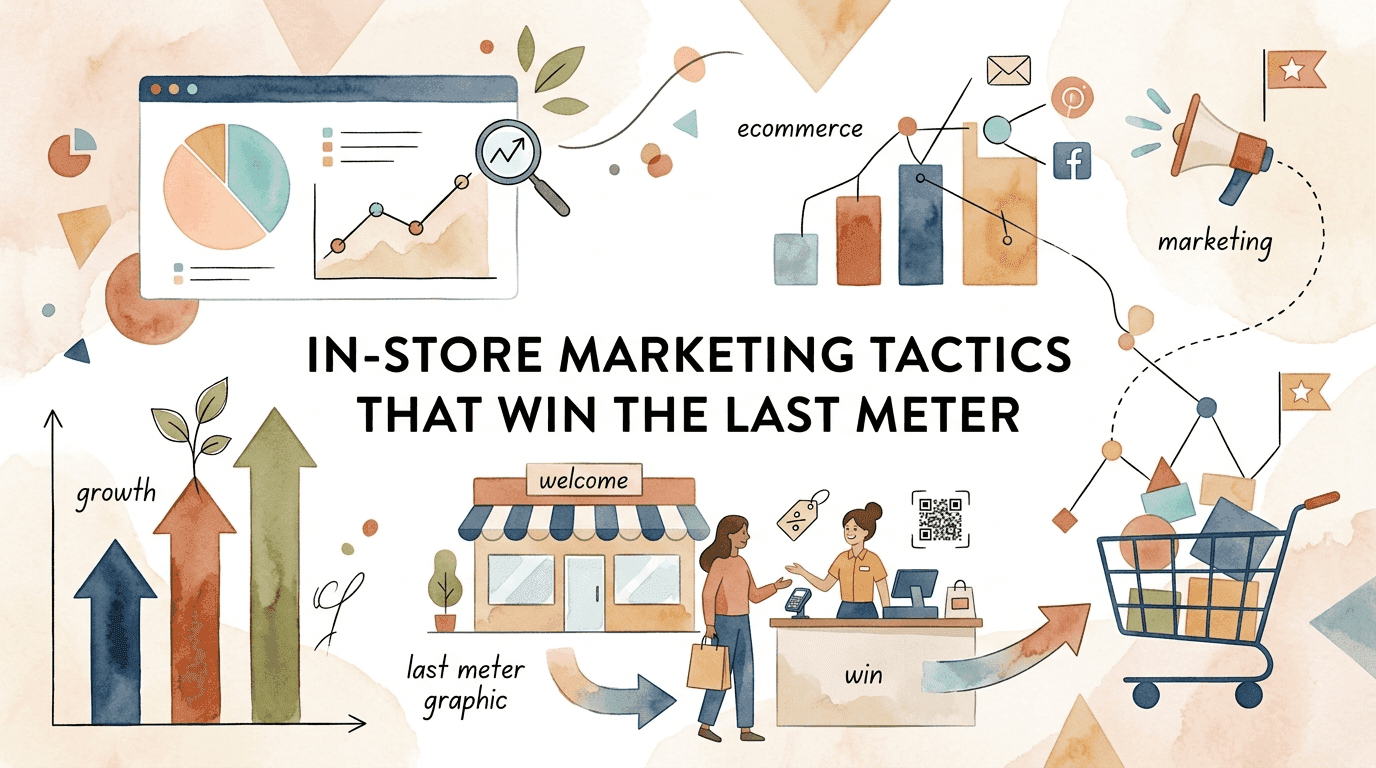
In-Store Marketing Tactics That Win the Last Meter
The average $1M to $10M FMCG operator spends north of 70% of marketing budget on the part of the customer journey that happens before the shopper enters the store. TV spots, programmatic display, social ads, influencer drops, mailer flyers. All of it firing in the living room, in the feed, in the inbox. Then the brand team waits for scan data to come back and quietly blames the retailer when the sell-through arrives soft.
That media mix is a confession. It says the brand believes the shopper has already made up their mind by the time they reach the aisle. The hard data says they have not.
In-store marketing tactics are the cheapest performance media a physical-product brand has access to, and the line item most operators under-fund.
The 76 Percent Decision Window You Are Not Buying
POPAI's 2012 Shopper Engagement Study, drawn from more than 2,400 in-mall interviews, 33,000 purchase receipts, and EEG plus eye-tracking data captured across 210 actual shopping trips, found that 76% of brand decisions are made inside the store, not before the shopper arrives. The number was POPAI 76 percent reported across the trade press at the time and has been the working benchmark for the industry ever since. The same study found that displays present at the shelf or end-of-aisle drove a 1.4 sales-lift index versus baseline weeks - the POPAI 2014 study restated this in its mass-merchant follow-up.
You should not take the headline number on faith. WireSpring published a careful contrarian read of the 76 percent figure that operators ought to read before they reorganise a budget around it. The WireSpring rebuttal argues that the figure conflates "decided in-store" with "responded to in-store stimulus," which are not the same thing. Engage Consultants made a similar Engage 76 dangerous point: in some categories, 76 percent overstates the in-store opportunity, particularly where brand loyalty is high and the shopper writes the brand name on the list at home.
Take the caveats. Then run your own back-of-envelope number. Pull last quarter's transaction file, subtract the share of units that came from a list-driven repeat buyer (loyalty match plus past-purchase signal), and what is left is your store-decided share. For most $1M to $10M FMCG operators, the floor is somewhere between 40 percent and 70 percent. Even at the lower bound, your media plan is mis-priced.
The cost of getting this wrong shows up as wasted POP spend. Brown POP losses walks through the standard pattern: a brand cuts the corrugated cost down to clear a margin target, ships a display that looks like a tax-write-off cardboard box, and the retailer either rejects the unit at the dock or installs it grudgingly in a graveyard slot at the back of the aisle. The display does not lift sell-through, the brand concludes "POP does not work for our category," and the budget shifts back to digital. That is the wrong lesson. The display worked when the brand respected the last meter as a media surface and built the whole programme around it.
The Last-Meter Decision Protocol: Three Zones That Carry the Sale
I call this the Last-Meter Decision Protocol. It is not a phasing of work, it is a map of the decision space. The shopper inside a grocery, mass, or specialty store is making three sequential decisions across the last meter of their purchase journey, and every dollar of in-store marketing tactics should land in one of those three zones with a measurement plan attached.
Zone one is the aisle approach. The shopper has decided to buy something in your category. They have not decided which brand. The decision happens in the eight to fifteen seconds between turning into the aisle and arriving at the shelf. This is where end-of-aisle displays, aisle violators, and category-entry shelf talkers fight to break the shopper out of autopilot. KDM shelf talkers catalogues the standard tactical kit at the price point a $1M to $10M operator can actually afford: shelf talkers, danglers, aisle violators, end-of-aisle wings.
Zone two is the shelf encounter. The shopper has reached the shelf. They have a four to six-second window where their eye scans the planogram and their hand starts to move. This is where your packaging, your shelf strip, your secondary placement on a side-kick, and your price-point signage do the work. Merit retail stats reports a 540 percent sales lift for well-designed versus cluttered POP at the shelf. The variance is enormous, which means the upside is enormous, which means leaving the shelf encounter under-funded is the single most expensive line item in a typical FMCG marketing plan.
Zone three is the checkout handoff. The shopper has the basket. They are stationary. The category-specific offer, the impulse pack, the cross-merchandised top-up at the register, the loyalty-card hand-back: this is where a brand can either complete the basket or exit the journey. For operators in confection, beverage, snack, or any high-frequency repeat-purchase category, the checkout handoff is where the unit-economics curve actually bends.
Run those three zones together and you have the Last-Meter Decision Protocol. The brand audits where its money currently lands, reallocates against the zones, and measures sell-through delta against a control set of stores. I have walked operators through the protocol who were spending less than 8 percent of marketing budget across the three zones combined. Their scan-data improvement when they pushed that share to 25 percent was visible inside one quarter.
Phase 1: The Spend Audit and Zone Map (Days 1-30)
Phase one is forensic. You cannot reallocate a budget you have not measured.
Pull the last 12 months of marketing spend by line item. Every invoice. TV, radio, print, programmatic, paid social, influencer, sponsorship, sampling, retailer co-op, slotting, POP, shelf talkers, end-cap rentals, secondary placements, aisle violators, gondola wraps, register displays, mailer, in-store demo, scan-back. If a dollar passed through a marketing P&L code, it goes on the list.
Open a spreadsheet with four columns. Pre-Store. Aisle Approach. Shelf Encounter. Checkout Handoff. Allocate every line item across the four buckets. A Meta brand-awareness campaign is 100 percent pre-store. A printed shelf talker is 100 percent shelf encounter. A retailer co-op end-cap deal usually splits between aisle approach (the placement) and shelf encounter (the on-shelf creative). Be honest with the splits. The point is not precision to the dollar, it is the share-of-spend pattern.
Once the totals are loaded, calculate the percentage in each bucket. The first time most operators run this audit, the number that comes back is roughly 72 percent pre-store, 9 percent aisle approach, 14 percent shelf encounter, 5 percent checkout handoff. That is the bug, not a feature. The decision happens inside the store and the budget lives outside it.
Phase one also carries a physical task. Go to ten of your top-velocity stores. Walk the category aisle as a shopper would. Photograph every brand's presence in each of the three zones. Score yours against the leader and the follower. Wiser POP business frames this as a decision-zone audit and is a fair primer for the team member you assign to the field walk. You are looking for two things: where you have visible presence and where the category leader has presence that you do not.
By day 30 you should have a single-page summary showing the four-bucket spend split, the zone-by-zone presence audit across ten stores, and a ranked list of the five biggest gaps. Bring that page into phase two.
Phase 2: Reallocation and Retailer Asks (Days 31-90)
Phase two is the move. You take the gap list from phase one and execute against it.
Start with the cheapest gap-fill: shelf talkers and danglers. A 90-day shelf talker print and ship programme for a 200-store distribution footprint runs in the low five-figures, including artwork. The rejection rate at the retailer level is usually under 20 percent if you brief the field-rep team correctly. This is the most under-rated tactic in the protocol because it is small money, it lives in zone two where the decision actually gets made, and it can be turned around in 14 days.
Next, line up secondary placements. Sidekicks, clip-strips, gondola end-displays, dump bins. These are aisle-approach and shelf-encounter plays. The retailer trade-marketing team will say yes to a secondary placement programme if you bring three things to the table: a co-funding contribution, a clear category insight ("our research shows shoppers in this aisle are basket-completing toward category X, here is the cross-merch logic"), and a defined window with a measurement plan. The trade money you spend on secondary placement returns measurably better than the same dollar spent on a flyer drop, in my experience across FMCG operators in the $1M to $10M band.
Then book end-cap windows. End-caps are the most expensive aisle-approach tactic and the most over-rated. They work, but only when the on-cap creative does the lifting. A blank end-cap full of pallet-stacked SKUs without a hero message and without a price-point cue earns roughly half what the same end-cap earns with a well-designed hero panel. Treat the end-cap window as a media buy with a creative requirement, not a placement requirement.
Finally, attack the checkout handoff. Most $1M to $10M operators ignore this zone because it requires negotiated retailer access. The route in is usually a small-format SKU built specifically for the checkout cooler, basket caddy, or register dump. If you do not have a checkout SKU, the phase-two task is to brief one. The economics of a single-serve, impulse-priced SKU at register placement are the strongest in the brand's range, and the line item rarely shows up on the marketing plan because brand teams treat it as a packaging decision rather than a marketing decision.
Across all four moves, the retailer-facing ask matters as much as the creative. Build a one-page activation brief per retailer per quarter with the zone, the placement, the creative, the timing, the co-funding split, and the measurement plan. The trade-marketing team is your buyer. Treat them like a buyer, with a sales pitch, not like a vendor with an invoice.
The New North Star: Sell-Through Lift Per Last-Meter Dollar
Phase three is the measurement layer, and it is where most in-store programmes quietly die. The brand spent the money, the displays shipped, the photographs came back, and nobody tied the spend to a sell-through delta against a control set.
Build the control before the activation ships. Pick 20 to 30 stores in the activation set. Match them on volume, region, format, and trailing-12-month velocity to a control set of equivalent stores that will not receive the activation. When the scan data lands, compare the activated cluster against the control cluster across the activation window plus a 30-day trailing window. The number you care about is incremental units per activated store per week against control. Multiply by net margin and divide by the protocol cost. That is your sell-through lift per last-meter dollar, and it is the only metric that matters.
This is the metric that turns the Last-Meter Decision Protocol from a media reorganisation into a discipline. Every quarter you run it. Every activation gets a control. Every dollar inside the three zones earns or loses its line on the plan. Within two cycles, you know which retailer, which zone, and which creative pattern returns and which one does not.
The brands I watch winning at the $1M to $10M FMCG level are not the ones with the slickest TV creative. They are the ones whose marketing director can pull up a spreadsheet and tell you the sell-through lift per dollar of every last-meter activation across the trailing four quarters. The audit, the reallocation, and the control-store measurement are the entire game. The cost of running the protocol is small. The cost of not running it is the 76 percent of decisions you are spending the rest of your budget around.
There is a softer version of the same point. When the marketing director can speak to in-store sell-through with the same fluency as digital ROAS, the relationship with the retailer changes. The trade-marketing team starts to listen. The buyer accepts more activation requests. The next quarter's plan gets co-funded at a higher share. Over four quarters the brand graduates from being a vendor that ships SKUs to being a partner that grows the category. That is the compound benefit of running the discipline, and it does not show up in the first cycle.
You do not need a bigger marketing budget. You need to fund the meter where the decision actually lives, measure it, and run that loop every quarter without breaking it.
Unit Economics Calculator
Contribution margin per order after COGS, shipping and fees — the number scaling actually depends on.
Point of Purchase Displays: Stop Shipping Into Black Holes
Sampling Campaign Management That Survives Past Day One
Cross-Merchandising Strategies That Actually Lift Basket Size
Planogram Optimization Strategies for Growing CPG Brands
Rebuild Attribution for Subscription Businesses in 90 Days
Advanced Reporting Solutions for Shopify Operators
Newsletter
The Uncommon Insights Letter
Practical FMCG & eCommerce growth playbooks — margins, retention and scaling tactics, straight to your inbox.
Turn fmcg strategy into profit you can see
Get a hands-on operator to turn the frameworks above into results — book a free audit call.