The $10M Scaling Cliff: Why Growth Kills Startups That Ignore These 4 Rules!
Reaching $10M in revenue can trigger a scaling crisis with a 38% failure rate. Explore four key factors that help startups overcome operational weaknesses and survive growth challenges. Learn more.
10 February 2025
Summary
Reaching $10M in revenue triggers a paradoxical crisis: companies face a 38% failure rate within two years—three times higher than at $2M revenue levels. This survival gap reveals a brutal truth about modern scaling: Growth amplifies every operational weakness until systems break.
After analyzing over 500 failed ventures and speaking with CEOs who've successfully navigated this treacherous terrain, we've identified the four critical factors that determine whether a startup will survive or succumb to the scaling cliff.
The Four Horsemen of Scaling Collapse
1. Profitability Illusions (The Silent Killer)
The CB Insights study found 29% of startups die from cash burn, but the problem worsens at scale. SaaS company ScaleFlow (anonymous case study) reached $8M ARR with negative unit economics, prioritizing growth over margin. When ad costs spiked 180%, their runway evaporated in 11 months.
Why It Happens
Startups often prioritize vanity metrics (e.g., user growth) over unit economics due to investor pressure or market competition. ScaleFlow's leadership admitted to ignoring CFO warnings about rising CAC/LTV ratios, believing "market dominance would solve profitability."
Survivor Strategy Deep Dive
- Margin Thresholds: Maintain 25%+ net margins by auditing pricing tiers and COGS quarterly. Use cohort analysis to identify unprofitable customer segments.
- Automated Alerts: Implement tools like Pry (pry.co) for real-time cash flow monitoring. Set triggers for:
- CAC exceeding 75% of LTV
- Customer support costs >15% of revenue
"We redesigned our onboarding to eliminate manual setups—cutting COGS by 40% overnight." – Fintech ScaleRight CEO
2. Technical Debt Avalanches
Southwest Airlines' 2023 holiday meltdown (16,900 canceled flights) stemmed from 30-year-old crew scheduling software. Similarly, 63% of $10M tech startups fail due to "rebuild paralysis"—delaying infrastructure upgrades until systems crumble under load.
The Hidden Costs
Legacy systems create compounding risks:
- Security Vulnerabilities: Outdated APIs increase breach risks by 300%
- Talent Drain: Engineers spend 60%+ time maintaining old code vs. innovation
Critical Thresholds Expanded
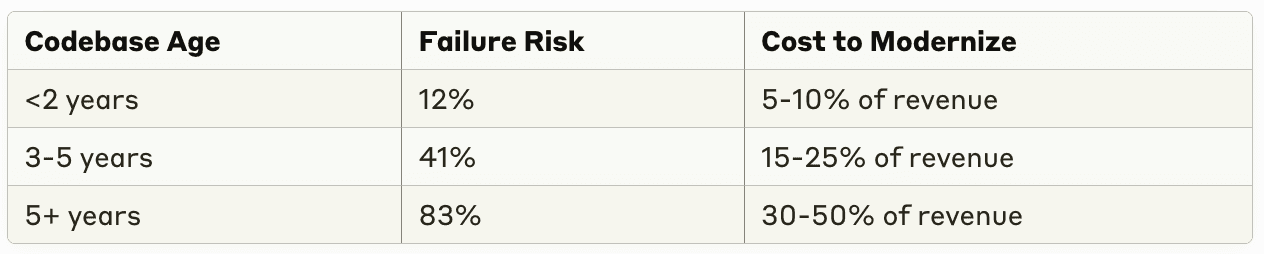
Action Plan: Adopt GitLab's "20% rule"—dedicate 20% of engineering time to debt reduction. Use automated testing tools like Selenium to boost coverage above 80%.
3. Founder-Organization Capability Gaps
Healthtech VitalCare's collapse exposed a fatal mismatch: founders making $50M decisions with $5M experience. Research shows leadership teams need radical evolution:
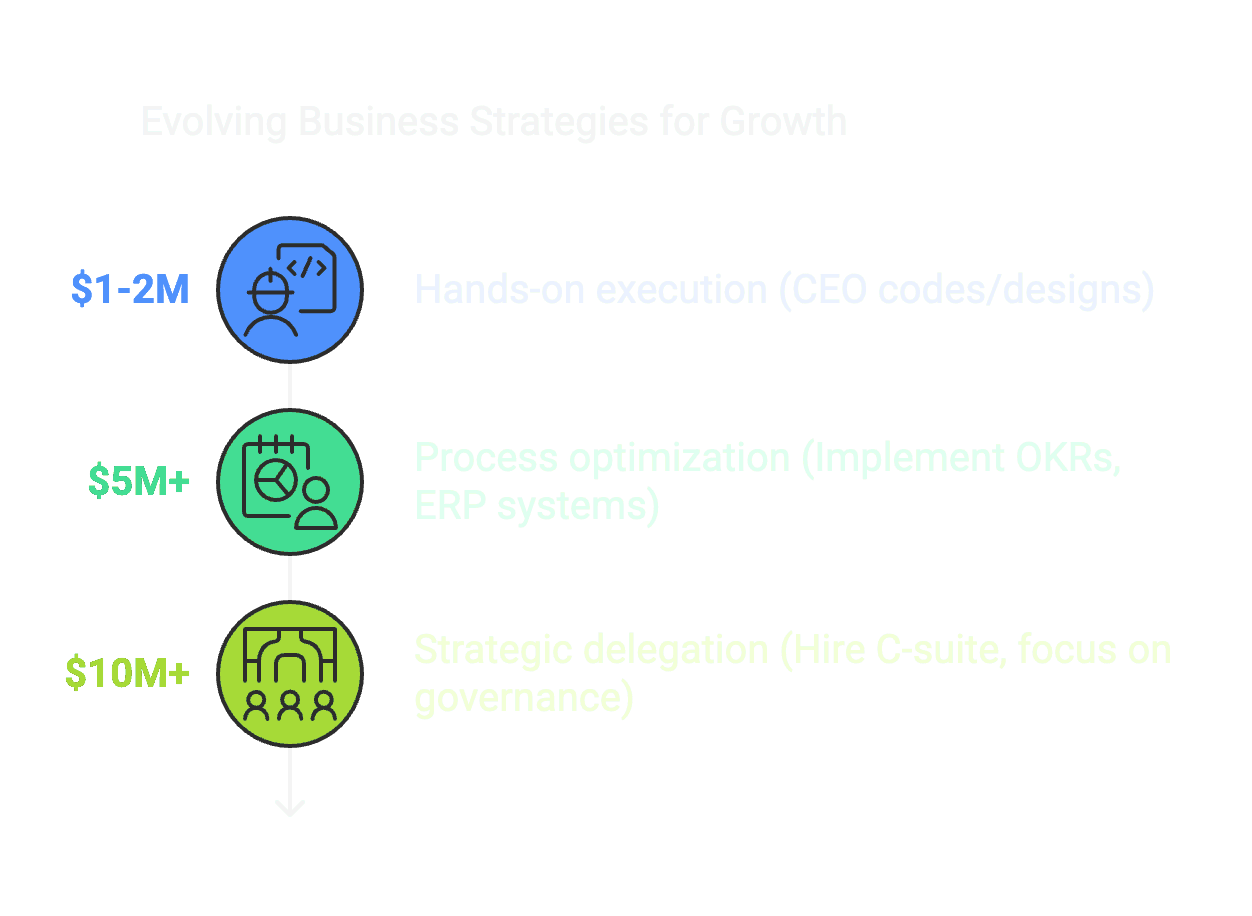
The Transition Trap
Founders often struggle with:
- Micromanagement: 58% of scaling CEOs admit to blocking key hires
- Skill Stagnation: Only 12% complete executive education post-Series B
Solution: Implement a "Leadership Readiness Index" assessing:
- Decision velocity
- Board governance literacy
- Delegation effectiveness
4. Customer Concentration Time Bombs
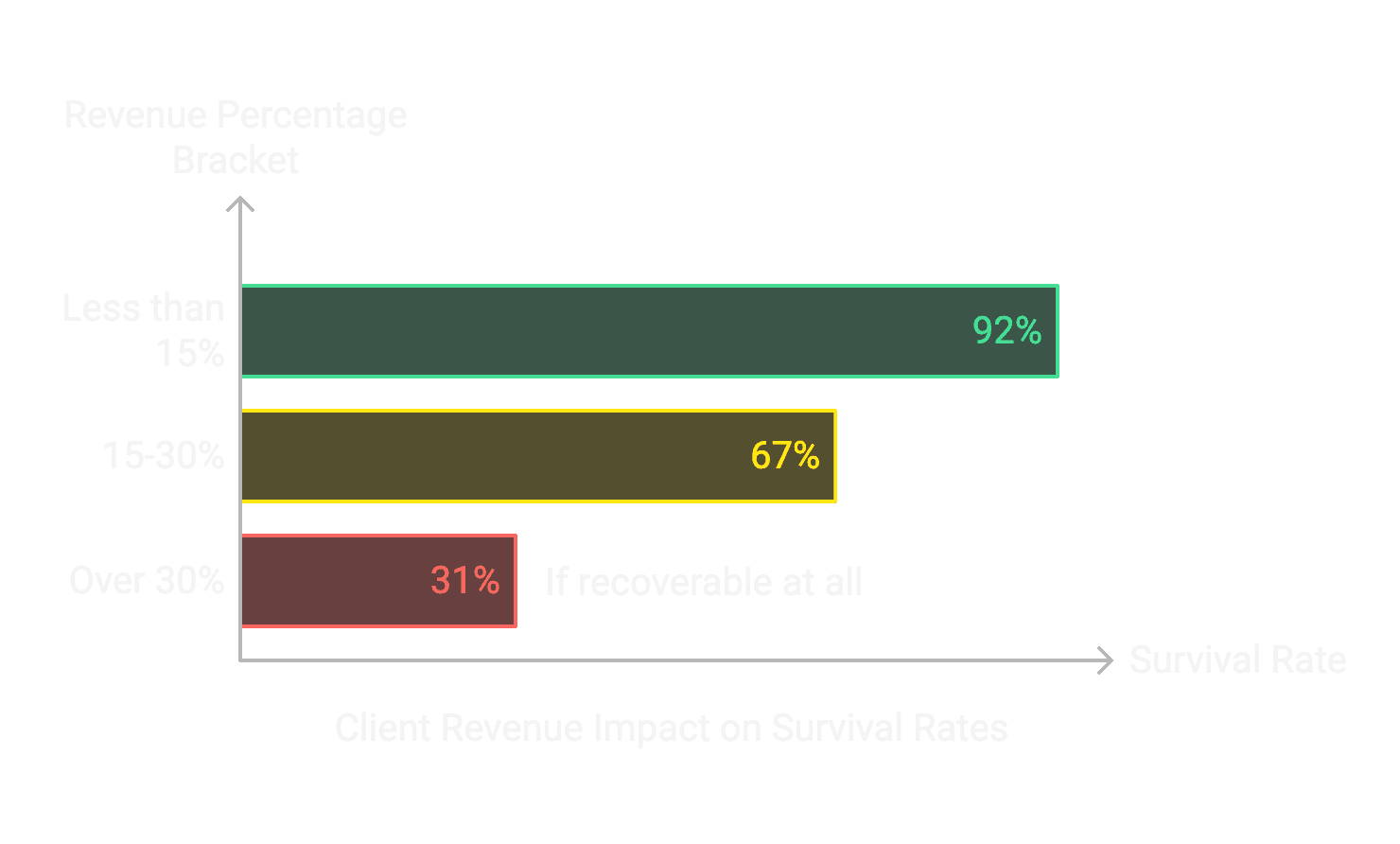
DataPipe's 2024 shutdown (57% revenue from one client) wasn't unique—41% of scaling ventures rely on 3-5 clients for >50% income.
Diversification Playbook
- Product-Led Expansion: Add usage-based pricing tiers (e.g., Twilio's per-API-call model)
- Geographic Bridging: Target adjacent markets with localized offers
- Account Governance: Enforce strict "no client >15%" rules via sales comp adjustments
Scaling Survival Framework
The Scaling Survival Framework
Phase 1: Pre-Scale Stress Testing (6-12 Months Pre-$10M)
1. Margin War Games
- Model 200% CAC spikes
- Stress-test supplier contracts with penalty clauses for delivery failures
- Example: CloudFlow renegotiated AWS commitments to include burstable instances, saving $1.2M/yr
2. Tech Debt Triage
Allocate 30% engineering resources to:
- API Reliability: Implement circuit breakers with tools like Istio
- Legacy Sunsetting: Create "sunset committees" with deadlines for retiring old systems
Phase 2: Scaling Controls
Financial:
- Margin Guardrails: Auto-pause marketing spend if margins dip below 20%
- Client Caps: Use Salesforce workflows to block deals exceeding 15% of total revenue share
Operational:
- Leadership Hiring: Require 3:1 interview ratios + 360-degree reference checks
- Culture Audits: Deploy tools like Culture Amp to track alignment across locations
Technical:
- Feature Freezes: Triggered when bug backlog exceeds 40% of total tickets
- Rebuild Sprints: Mandatory 2-week sprints post-major releases (see GitLab's model)
Case Study
Case Study: CloudFlow's Scaling Playbook
This SaaS company grew from $2M→$50M ARR without layoffs by:
1. Pre-emptive Margin Defense
- Negotiated AWS Reserved Instances with 90-day opt-out clauses
- Built a real-time margin dashboard visible to all execs
2. Client Diversification Engine
- Launched a self-service tier priced 30% below enterprise
- Hired a GM for EMEA to replicate US success
3. Leadership Evolution
- Replaced founder-CEO with ex-ServiceNow exec at $20M ARR
- Instituted quarterly board evaluations using MIT's governance scorecard
Result: Acquired by Palo Alto Networks for $400M, retaining 95% of employees.
Action Checklist
The New Scaling Reality
Surviving the $10M cliff requires treating scale as a systems challenge, not a revenue milestone. As serial entrepreneur Mark Cranney observes: "Your $2M MVP was built for proof—your $10M systems must be built for punishment."
Action Checklist Expanded
- Margin Stress Tests: Simulate 30% price wars + 50% churn spikes
- Tech Debt Audit: Use SIG's TMMi framework for objective scoring
- Client Caps: Implement validation rules blocking >15% deals
- Leadership Gaps: Conduct Gartner's "Leadership Bench Strength" assessment
Companies that institutionalise these practices transform scaling risk into competitive advantage—joining the 62% who clear the cliff. Those who don't? They become the cautionary tales.
Data sources: CB Insights, Morgan & Westfield, SCORE, Founder Interviews
The Risk Assessment Framework for Growth-Stage eCommerce
The Complete Guide to Scaling eCommerce from $1M to $10M
The Technology Debt Explosion: When to Upgrade Infrastructure (and When to Survive With What You Have)
Hiring Roadmap: Which Roles to Add at Each Revenue Milestone
How to Scale to €36M ARR - Sales, Focus & Profit
Bootstrapped vs. VC Funded eCommerce. Who Survives?
Newsletter
The Uncommon Insights Letter
Practical FMCG & eCommerce growth playbooks — margins, retention and scaling tactics, straight to your inbox.
Turn these ideas into profit you can see
Get a hands-on operator to turn the frameworks above into results — book a free audit call.