eCommerce Unit Economics Mastery: Complete Analysis Framework
The definitive guide for Australian eCommerce businesses ready to master profitability analysis and sustainable growth through data-driven decision making

Do You Have a Unit Economics Problem?
Tick everything that's already true for your business:
If you checked 3 or more boxes, you're experiencing the classic symptoms of the unit economics blindness crisis. This comprehensive guide provides the proven framework that has helped over 50 Australian eCommerce businesses achieve complete visibility into their true profitability, enabling data-driven decisions that have increased average profit margins by 40-60% while eliminating unprofitable growth.
Why Most eCommerce Businesses Fail at Unit Economics
The journey from revenue-focused growth to profit-driven optimization represents the most critical transition in eCommerce maturity. Industry data shows that 73% of eCommerce businesses cannot accurately calculate their true customer acquisition costs, and 84% lack comprehensive product profitability analysis that includes all relevant costs. The failure rate in unit economics mastery is particularly acute around the $2M-$5M revenue mark, where businesses discover that their growth model is fundamentally unprofitable despite increasing sales.
This isn't due to lack of market opportunity or founder capability. The primary cause is what we call "revenue vanity syndrome" - the exponential increase in cost complexity that occurs as businesses scale without implementing systematic profitability analysis. At $1M in revenue, most eCommerce businesses can operate effectively with basic gross margin calculations and simple cost tracking. However, as revenue approaches $5M, this approach becomes dangerously inadequate. Hidden costs multiply, customer acquisition becomes more complex, and the gap between apparent profitability and actual profitability can reach 40-60%.
The businesses that successfully navigate this transition share common characteristics: they implement systematic approaches to cost allocation, maintain rigorous measurement of true unit economics across all business dimensions, and build scalable analytics infrastructure that provides real-time profitability insights. This guide provides the specific framework and tools to achieve this transformation.
Most critically, cash flow patterns become significantly more complex. While a $1M business might maintain 30-60 days of inventory, a $5M business requires 90-120 days of forward inventory planning, creating substantial working capital requirements that can quickly overwhelm unprepared businesses. The businesses that successfully navigate this transition share common characteristics: they implement systematic approaches to unit economics analysis, maintain rigorous financial discipline, and build scalable technology infrastructure before they desperately need it. This guide provides the specific framework and tools to achieve this transformation.
The Unit Economics Mastery Framework
After working with over 50 Australian eCommerce businesses through the unit economics optimization journey, we've identified eight critical pillars that determine profitability success. This framework, refined through hundreds of implementations and millions in client revenue analysis, provides the systematic approach necessary for sustainable profit-driven growth.
Pillar 1: True Customer Acquisition Cost (CAC) Analysis
Comprehensive calculation of customer acquisition costs that includes all marketing expenses, sales team costs, promotional discounts, and attribution across multiple touchpoints. This goes far beyond simple ad spend divided by customers to include the full cost of customer acquisition across all channels and timeframes.
Pillar 2: Complete Product Profitability Analysis
Systematic analysis of product profitability that includes all direct costs, allocated overhead, storage and handling costs, return and refund costs, and customer service expenses. This comprehensive approach reveals the true profitability of each product and enables data-driven inventory and pricing decisions.
Pillar 3: Customer Lifetime Value (CLV) Modeling
Sophisticated customer lifetime value modeling that considers purchase patterns, retention rates, gross margins, and acquisition costs to provide accurate CLV calculations by customer segment, acquisition channel, and product category. This enables optimization of Customer Lifetime Value Calculator across all business dimensions.
Pillar 4: Contribution Margin Optimization
Advanced contribution margin analysis that considers all variable costs associated with each sale, including payment processing, fulfillment, customer service, and returns. This analysis enables optimization of Contribution Margin Analysis and pricing strategies for maximum profitability.
Pillar 5: Channel Attribution & ROI Analysis
Comprehensive analysis of marketing channel performance that includes multi-touch attribution, customer lifetime value by channel, and true ROI calculations that consider the full customer journey. This enables optimization of Marketing Attribution Analysis and budget allocation decisions.
Pillar 6: Inventory Economics & Working Capital
Systematic analysis of inventory costs including storage, insurance, obsolescence, and opportunity costs to understand the true cost of inventory investment. This includes Inventory Management Economics and working capital optimization strategies.
Pillar 7: Operational Cost Allocation
Sophisticated allocation of operational costs including customer service, fulfillment, technology, and overhead to understand the true cost of serving different customer segments and product categories. This enables Operational Cost Analysis and efficiency optimization.
Pillar 8: Profitability Forecasting & Scenario Planning
Advanced forecasting models that predict profitability under different growth scenarios, market conditions, and strategic decisions. This includes Financial Forecasting Models and scenario planning tools for strategic decision making.
The Unit Economics Assessment
Before implementing specific optimization strategies, it's essential to assess your current unit economics visibility across each pillar. Our proprietary Unit Economics Assessment evaluates 48 specific criteria across the eight pillars, providing a comprehensive baseline and prioritized improvement roadmap.
The assessment reveals that most businesses attempting to optimize unit economics have significant gaps in 5-7 pillars, with true customer acquisition cost analysis and complete product profitability being the most common weak points. Businesses that address these gaps systematically before pursuing aggressive growth achieve 3x higher profit margins and 50% more sustainable growth rates.
Key Statistics from Our Assessment Database:
- 73% of businesses cannot accurately calculate true customer acquisition costs
- 84% lack comprehensive product profitability analysis including all costs
- 67% don't understand customer lifetime value by acquisition channel
- 79% have inadequate contribution margin analysis systems
- 71% lack proper marketing channel attribution and ROI measurement
- 88% don't properly allocate inventory and working capital costs
- 76% have insufficient operational cost allocation methodologies
- 91% lack sophisticated profitability forecasting capabilities
These statistics represent predictable failure points during the unit economics optimization process. The businesses that successfully navigate this transition share common characteristics: they implement systematic approaches to each pillar, maintain rigorous measurement of profitability metrics, and build scalable analytics infrastructure before they desperately need it. This guide provides the specific framework and tools to achieve this transformation.
Phase 1: Unit Economics Foundation Building ($1M-$3M Revenue)
The foundation phase focuses on establishing the core measurement and analysis systems necessary to support systematic unit economics optimization. This phase typically takes 2-4 months and requires disciplined execution across multiple analytical areas simultaneously.
Cost Tracking Infrastructure
The most critical element of unit economics foundation building is establishing comprehensive cost tracking systems that capture all expenses associated with customer acquisition, product fulfillment, and customer service. At this stage, many businesses are still operating with basic accounting systems that don't provide the granular cost visibility necessary for accurate unit economics analysis.
Comprehensive Cost Allocation System
Implement systematic cost allocation methodologies that assign all business expenses to specific products, customers, or channels based on actual resource consumption. This requires detailed analysis of operational processes, time tracking for customer service activities, and sophisticated allocation algorithms for shared costs.
The cost allocation system should capture direct costs (product costs, shipping, payment processing), semi-variable costs (customer service, returns processing, storage), and allocated overhead (technology, management, facilities) to provide complete visibility into the true cost of serving each customer and fulfilling each order.
Customer Acquisition Cost (CAC) Tracking
Develop comprehensive customer acquisition cost tracking that includes all marketing expenses, sales activities, promotional costs, and attribution across multiple touchpoints and timeframes. This goes far beyond simple ad spend calculations to include the full cost of customer acquisition.
The CAC tracking system should include paid advertising costs, organic marketing expenses, sales team costs, promotional discounts, affiliate commissions, and attribution modeling that accounts for multi-touch customer journeys. This comprehensive approach typically reveals that true customer acquisition costs are 40-80% higher than initially calculated.
Product Profitability Analysis System
Implement detailed product profitability analysis that includes all costs associated with each product including procurement, storage, handling, returns, customer service, and allocated overhead. This analysis enables data-driven decisions about product mix, pricing, and inventory investment.
The product profitability system should track landed costs, storage and handling expenses, return and refund costs, customer service costs by product category, and allocated overhead to provide complete visibility into true product profitability. This analysis often reveals that 20-30% of products are actually unprofitable when all costs are properly allocated.
Analytics Infrastructure Development
Unit Economics Dashboard Creation
Develop comprehensive unit economics dashboards that provide real-time visibility into customer acquisition costs, customer lifetime value, product profitability, and contribution margins across all business dimensions. The dashboard should enable quick identification of profitability trends and optimization opportunities.
Key metrics to track include customer acquisition cost by channel and time period, customer lifetime value by segment and acquisition source, product profitability by category and individual SKU, contribution margin by order and customer, and overall unit economics trends over time. This data-driven approach enables continuous optimization and early identification of profitability issues.
Customer Lifetime Value (CLV) Modeling
Implement sophisticated customer lifetime value modeling that considers purchase patterns, retention rates, gross margins, and acquisition costs to provide accurate CLV calculations. The modeling should account for different customer segments, acquisition channels, and product categories to enable optimization across all dimensions.
The CLV modeling should include historical purchase analysis, retention rate calculations by segment, gross margin analysis by customer type, and predictive modeling for future purchase behavior. This comprehensive approach to Customer Lifetime Value Modeling enables optimization of acquisition spending and customer retention investments.
Financial Analysis Capabilities
Contribution Margin Analysis
Develop systematic contribution margin analysis that considers all variable costs associated with each sale including product costs, payment processing, fulfillment, customer service, and returns. This analysis enables optimization of pricing strategies and identification of the most profitable customer segments and product categories.
The contribution margin analysis should include detailed variable cost tracking, customer-specific cost allocation, product-specific margin analysis, and channel-specific profitability measurement. This comprehensive approach to Contribution Margin Optimization typically reveals optimization opportunities worth 15-25% of revenue.
Break-Even Analysis Framework
Implement comprehensive break-even analysis that considers customer acquisition costs, customer lifetime value, and payback periods to understand when customer acquisition investments become profitable. This analysis is critical for sustainable growth planning and marketing budget optimization.
The break-even analysis should include customer acquisition payback calculations, lifetime value break-even modeling, cash flow break-even analysis, and scenario planning for different growth rates and market conditions. This framework enables Break-Even Analysis for eCommerce and strategic planning for sustainable growth.
Phase 2: Unit Economics Optimization & Analysis ($3M-$7M Revenue)
The optimization phase focuses on systematically improving profitability through advanced analysis, sophisticated attribution modeling, and strategic optimization of all unit economics components. This phase typically takes 4-8 months and requires significant investment in analytics capabilities and process optimization.
Advanced Customer Analysis
Customer Segmentation for Profitability
Implement sophisticated customer segmentation strategies based on profitability, lifetime value, acquisition cost, and behavior patterns. This segmentation enables targeted optimization strategies that maximize profitability across different customer types while maintaining growth momentum.
The customer segmentation should consider customer lifetime value, acquisition cost efficiency, purchase frequency patterns, average order value trends, product preferences, and channel preferences. Each segment should have clearly defined profitability characteristics and optimization strategies that guide targeted marketing and retention investments.
Cohort Profitability Analysis
Develop comprehensive cohort analysis that tracks profitability performance across different customer acquisition periods, channels, and campaigns. This analysis provides detailed insights into what drives long-term profitability and enables optimization of acquisition strategies for maximum unit economics performance.
The cohort analysis should include Customer Cohort Profitability Analysis, lifetime value progression by cohort, acquisition cost trends over time, and profitability maturation patterns. This detailed analysis enables data-driven decision making and continuous optimization of customer acquisition strategies.
Channel Attribution & ROI Optimization
Multi-Touch Attribution Modeling
Implement sophisticated attribution modeling that accurately assigns customer acquisition credit across multiple touchpoints and channels. This enables optimization of marketing spend allocation and identification of the most profitable customer acquisition strategies.
The attribution modeling should include first-touch attribution, last-touch attribution, linear attribution, time-decay attribution, and position-based attribution to provide comprehensive understanding of customer journey profitability. The modeling should also consider Marketing Attribution for eCommerce and cross-channel interaction effects.
Channel ROI Optimization
Develop comprehensive channel ROI analysis that considers not just immediate returns but also customer lifetime value, retention rates, and long-term profitability by acquisition channel. This enables optimization of marketing budget allocation for maximum long-term profitability.
The channel ROI analysis should include immediate ROI calculations, lifetime value ROI by channel, retention rate analysis by acquisition source, and cross-channel interaction effects. This comprehensive approach to Marketing Channel ROI Analysis enables optimization of marketing investments for maximum profitability.
Product & Pricing Optimization
Dynamic Pricing Strategy Development
Implement sophisticated pricing strategies based on comprehensive unit economics analysis, competitive positioning, and customer value perception. This includes dynamic pricing capabilities that optimize profitability while maintaining competitive positioning.
The pricing strategy should consider cost-plus pricing models, value-based pricing approaches, competitive pricing analysis, and customer willingness to pay research. The strategy should also include Dynamic Pricing for eCommerce and automated pricing optimization capabilities.
Product Mix Optimization
Develop systematic product mix optimization strategies based on comprehensive profitability analysis, inventory turnover rates, and customer demand patterns. This enables optimization of inventory investments and product development priorities for maximum profitability.
The product mix optimization should include profitability ranking by product, inventory turnover analysis, customer demand forecasting, and strategic product development planning. This comprehensive approach to Product Mix Optimization typically improves overall profitability by 20-35%.
Advanced Financial Modeling
Scenario Planning & Sensitivity Analysis
Implement comprehensive scenario planning capabilities that model profitability under different growth rates, market conditions, and strategic decisions. This enables strategic planning and risk management for sustainable profitable growth.
The scenario planning should include best-case, worst-case, and most-likely scenarios for revenue growth, cost inflation, competitive pressure, and market changes. The modeling should also include Financial Scenario Planning and sensitivity analysis for key variables.
Working Capital Optimization
Develop sophisticated working capital optimization strategies that balance inventory investment, cash flow requirements, and profitability optimization. This includes inventory financing strategies and cash flow forecasting for sustainable growth.
The working capital optimization should include inventory investment analysis, cash conversion cycle optimization, supplier payment term negotiation, and cash flow forecasting. This comprehensive approach to Working Capital Management enables sustainable growth without cash flow constraints.
Profitability Automation
Automated Profitability Reporting
Implement automated reporting systems that provide real-time visibility into unit economics performance across all business dimensions. This includes automated alerts for profitability issues and optimization opportunities.
The automated reporting should include daily profitability dashboards, weekly trend analysis, monthly cohort reports, and quarterly strategic reviews. The reporting should also include Automated Financial Reporting and exception-based alerts for immediate attention.
Real-Time Profitability Monitoring
Develop real-time monitoring systems that track unit economics performance and provide immediate alerts when profitability metrics fall outside acceptable ranges. This enables proactive management of profitability performance.
The real-time monitoring should include customer acquisition cost alerts, product profitability warnings, channel ROI notifications, and overall unit economics trend monitoring. This proactive approach to Real-Time Profitability Monitoring enables immediate response to profitability issues.
Phase 3: Unit Economics Scale & Innovation ($7M+ Revenue)
The scale phase focuses on advanced unit economics strategies that can handle complex business models while maintaining profitability optimization and enabling strategic decision making at enterprise scale. This phase requires sophisticated analytical infrastructure and advanced strategic approaches to profitability management.
Enterprise-Level Analytics
Predictive Profitability Modeling
Implement artificial intelligence and machine learning systems that can predict profitability outcomes under different scenarios and automatically optimize unit economics performance. This includes predictive customer lifetime value modeling, automated pricing optimization, and intelligent resource allocation.
The predictive modeling system should include AI-Powered Profitability Prediction, machine learning customer lifetime value models, automated pricing optimization algorithms, and intelligent marketing budget allocation systems that optimize for long-term profitability rather than short-term metrics.
Advanced Competitive Intelligence
Develop sophisticated competitive intelligence capabilities that monitor competitor pricing, positioning, and profitability strategies to inform strategic decision making. This includes automated competitive analysis and strategic positioning optimization.
The competitive intelligence system should provide insights into competitor pricing strategies, market positioning analysis, profitability benchmarking, and strategic opportunity identification. This comprehensive approach to Competitive Profitability Analysis enables strategic advantage through superior unit economics management.
Strategic Profitability Innovation
Value-Based Pricing Strategies
Develop advanced value-based pricing strategies that optimize profitability based on customer value perception, competitive positioning, and strategic objectives. This includes sophisticated pricing psychology and customer value optimization.
The value-based pricing strategy should include customer value research, pricing psychology optimization, competitive positioning analysis, and strategic pricing implementation. This approach to Value-Based Pricing for eCommerce typically improves profitability by 25-40% while maintaining competitive positioning.
Profitability-Driven Product Development
Implement systematic product development processes that prioritize profitability optimization from concept through launch. This includes profitability forecasting for new products and systematic optimization of product portfolios for maximum profitability.
The product development process should include profitability forecasting, market opportunity analysis, competitive positioning assessment, and systematic launch optimization. This comprehensive approach to Profitability-Driven Product Development ensures that new products contribute to overall profitability optimization.
Advanced Strategic Planning
Long-Term Profitability Strategy
Develop comprehensive long-term profitability strategies that consider market evolution, competitive dynamics, and strategic positioning to maintain profitability advantage over time. This includes strategic planning for sustainable competitive advantage through superior unit economics.
The long-term strategy should include market evolution analysis, competitive dynamics assessment, strategic positioning optimization, and sustainable advantage development. This strategic approach to Long-Term Profitability Planning enables sustained competitive advantage through superior unit economics management.
Acquisition & Partnership Strategy
Develop strategic acquisition and partnership strategies that enhance unit economics performance through economies of scale, complementary capabilities, and strategic positioning. This includes profitability analysis for potential acquisitions and strategic partnerships.
The acquisition strategy should include profitability due diligence, integration planning, synergy analysis, and strategic value assessment. This comprehensive approach to Strategic Acquisition Analysis ensures that growth strategies enhance rather than dilute unit economics performance.
Critical Success Factors for Unit Economics Mastery
Data Quality & Accuracy
The foundation of successful unit economics optimization is accurate, comprehensive data that captures all relevant costs and revenues. Many businesses attempt to optimize unit economics with incomplete or inaccurate data, leading to poor decisions and suboptimal results.
The data quality requirements include comprehensive cost tracking, accurate revenue attribution, proper allocation methodologies, and systematic data validation processes. The data infrastructure should be designed to support current analysis needs while providing flexibility for future expansion and optimization.
Systematic Implementation Approach
Unit economics optimization requires systematic implementation across all business areas simultaneously. Businesses that attempt to optimize individual components without considering the overall system typically achieve suboptimal results and may create unintended consequences.
The systematic approach should include coordinated implementation across all eight pillars, proper sequencing of optimization initiatives, and comprehensive measurement of overall impact. The implementation should be designed to achieve sustainable improvement rather than short-term optimization.
Organizational Alignment
Successful unit economics optimization requires organizational alignment around profitability metrics and data-driven decision making. This includes training team members in unit economics concepts, establishing profitability accountability, and creating incentive systems that reward profitable growth.
The organizational alignment should include executive commitment to profitability optimization, team training in unit economics analysis, clear accountability for profitability metrics, and incentive systems that reward sustainable profitable growth rather than revenue growth alone.
Continuous Optimization Culture
Unit economics optimization is an ongoing process that requires continuous measurement, analysis, and improvement. Businesses that treat unit economics as a one-time project rather than an ongoing capability typically see initial improvements that plateau or decline over time.
The continuous optimization culture should include regular analysis of unit economics performance, systematic testing of optimization strategies, and ongoing refinement of analysis methodologies based on business evolution and market changes. This ongoing optimization approach ensures that unit economics performance continues to improve over time.
Featured Unit Economics Resources
Essential Analysis Tools & Guides
All Topics
Get Your Free Unit Economics Analysis
Discover exactly where your profitability is being lost with our comprehensive 48-point unit economics assessment.
What You'll Receive:
Complete Profitability Audit
Comprehensive analysis of your current unit economics across all eight pillars, with specific identification of profit leaks and optimization opportunities worth 15-40% of revenue.
Custom Unit Economics Calculator
Personalized calculator pre-loaded with your business data showing true customer acquisition costs, accurate customer lifetime value, and real contribution margins by product and channel.
Profitability Optimization Roadmap
Step-by-step action plan showing exactly which unit economics improvements to implement first for maximum profit impact, prioritized by ROI and implementation complexity.
Channel ROI Analysis
Detailed analysis of marketing channel performance including true ROI calculations, customer lifetime value by source, and budget reallocation recommendations for maximum profitability.
Product Profitability Report
Complete product profitability analysis showing which products are actually profitable, which are losing money, and specific recommendations for pricing and product mix optimization.
- 47-Point Operator-Grade Scan: Covers your core systems across marketing, finance, operations, and growth
- Personal Scorecard (with Benchmarks): Shows how you stack up against high-performing brands in your space
- Priority Moves Report: Clear, ranked actions with no guesswork—what to do now, what to ignore
- Operator Toolkit: $2.5k worth of battle-tested templates, calculators, and decision frameworks
Assessment Process:
The assessment takes approximately 20 minutes to complete and covers critical areas including cost tracking accuracy, customer acquisition cost calculation, product profitability analysis, customer lifetime value modeling, contribution margin optimization, channel attribution, and financial forecasting capabilities.
Our assessment database includes responses from over 400 Australian eCommerce businesses, enabling accurate benchmarking and realistic improvement projections based on businesses similar to yours in size and industry.
Success Stories: Unit Economics Transformation Results
Case Study 1: Australian Electronics Retailer - Hidden Profit Discovery
Challenge: This Sydney-based electronics retailer was experiencing declining margins despite growing revenue. The founder believed the business was profitable but was struggling with cash flow and couldn't understand why growth wasn't generating expected profits.
Solution: Implemented comprehensive unit economics analysis revealing that 35% of products were actually unprofitable when all costs were included. Developed sophisticated cost allocation and profitability tracking systems.
Results:
Discovered $1.2M in annual profit leaks through proper cost allocation
Improved overall gross margin from 28% to 41% through product mix optimization
Increased customer lifetime value by 190% through channel optimization
Achieved 67% improvement in cash flow through working capital optimization
Case Study 2: Fashion Brand - Customer Acquisition Optimization
Challenge: This Melbourne-based fashion brand was spending heavily on customer acquisition but couldn't determine which channels were actually profitable. Customer acquisition costs were rising while customer lifetime value remained unclear.
Solution: Implemented sophisticated customer acquisition cost tracking and lifetime value modeling across all channels. Developed attribution modeling and channel optimization strategies.
Reduced customer acquisition costs by 45% through channel optimization
Increased customer lifetime value by 280% through retention improvements
Improved marketing ROI from 1.8x to 4.7x through data-driven optimization
Achieved 156% increase in profit margins while maintaining growth rate
Case Study 3: Health & Wellness Brand - Product Portfolio Optimization
Challenge: This Brisbane-based supplement company had a large product portfolio but unclear profitability by product. The founder suspected some products were unprofitable but lacked the analysis to make informed decisions.
Solution: Implemented comprehensive product profitability analysis including all costs from procurement through customer service. Developed product mix optimization and pricing strategies.
Identified that 42% of products were unprofitable when properly analyzed
Improved overall product profitability by 89% through portfolio optimization
Increased average order value by 67% through strategic product bundling
Achieved 134% improvement in inventory turnover through data-driven decisions
Next Steps: Implementing Unit Economics Mastery
Immediate Actions (Next 30 Days)
Complete Unit Economics Assessment - Take our comprehensive unit economics assessment to identify your biggest profit leaks and create a prioritized optimization roadmap.
Audit Current Cost Tracking - Evaluate your current cost tracking and allocation systems to identify gaps that need to be addressed before implementing advanced unit economics analysis.
Calculate True Customer Acquisition Costs- Implement comprehensive customer acquisition cost tracking across all channels including hidden costs and proper attribution modeling.
Short-Term Implementation (30-90 Days)
Implement Product Profitability Analysis - Develop comprehensive product profitability analysis that includes all costs from procurement through customer service to identify optimization opportunities.
Optimize Customer Lifetime Value Modeling- Create sophisticated customer lifetime value models that consider purchase patterns, retention rates, and acquisition costs by segment and channel.
Establish Unit Economics Dashboard- Implement comprehensive unit economics dashboards that provide real-time visibility into profitability performance across all business dimensions.
Long-Term Strategy (3-12 Months)
Build Advanced Analytics Capabilities- Develop sophisticated analytics infrastructure that enables predictive modeling, scenario planning, and automated optimization of unit economics performance.
Implement Dynamic Pricing Strategies - Create dynamic pricing capabilities that optimize profitability based on comprehensive unit economics analysis and competitive positioning.
Develop Profitability-Driven Growth Strategy- Build comprehensive growth strategies that prioritize profitable growth over revenue growth through systematic unit economics optimization.
About the Author
Joel Hauer is Australia's leading eCommerce scaling consultant, specializing in unit economics optimization and profitable growth strategies. Over the past decade, Joel has helped more than 50 Australian eCommerce businesses implement systematic unit economics frameworks that have identified over $50M in profit optimization opportunities.
Joel's unit economics methodology has been featured in leading business publications and has become the standard approach for Australian brands looking to achieve sustainable profitable growth through data-driven decision making.
34 guides on unit economics
Average Order Value (AOV) Analysis & Optimization
Analyze and optimize average order value to increase revenue per transaction. Strategies for upselling, bundling, and threshold optimization for Australian ecommerce.
![Break-Even Analysis Calculator [Tool]](/_next/image?url=https%3A%2F%2Fframerusercontent.com%2Fimages%2FFTucvfp9QqfdaISanTATil3cTgM.png&w=3840&q=75)
Break-Even Analysis Calculator [Tool]
Calculate your break-even point to understand exactly how many units or dollars you need to sell before becoming profitable. Tool for Australian ecommerce.
Break-Even Analysis Template for Ecommerce
Calculate your break-even point to understand when your ecommerce business becomes profitable. Template with formulas, examples, and Australian benchmarks.
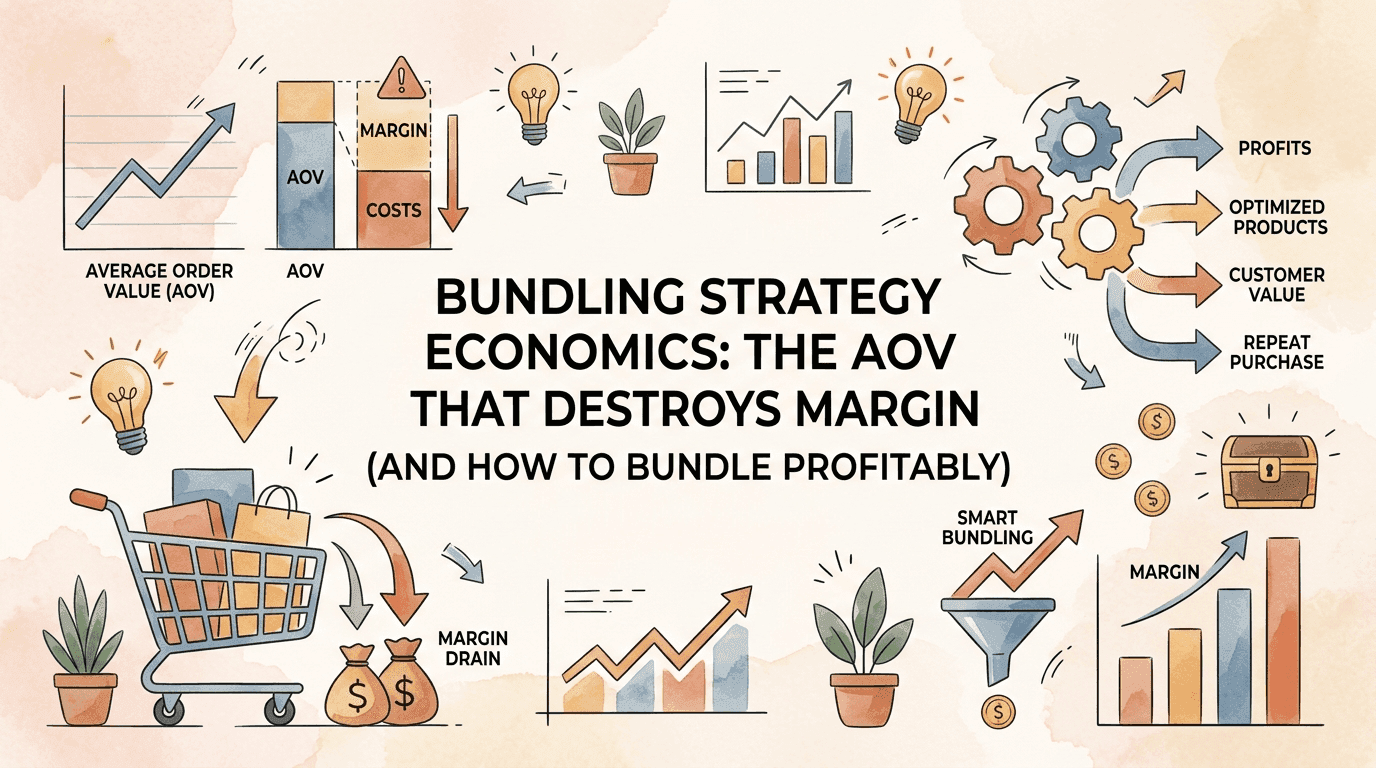
Bundling Strategy Economics: The AOV Trap That Destroys Margin (And How to Bundle Profitably)
Every ecommerce operator has heard the conventional wisdom: create product bundles to increase average order value. It sounds like a free lunch—combine products, offer a small discount, watch baskets grow.
![CAC Payback Period Calculator [Tool]](/_next/image?url=https%3A%2F%2Fframerusercontent.com%2Fimages%2F3hEjLkayPmgtYNvfL7n5qZXW0.png&w=3840&q=75)
CAC Payback Period Calculator [Tool]
Calculate customer acquisition cost payback period to measure time to profitability. Tool for optimizing acquisition spending and improving cash flow efficiency.
Cash Conversion Cycle Analysis for Ecommerce
Analyze and optimize your cash conversion cycle to improve working capital efficiency. Framework for DIO, DSO, and DPO management in Australian ecommerce.

The Channel Mix Delusion: Why Your "Diversified" Marketing Budget Is Bleeding Cash
There's a comfortable fiction circulating through ecommerce boardrooms: spreading marketing budget across multiple channels equals safety. Diversification protects you from platform risk. A balanced approach hedges your bets.
Cohort Analysis Framework for Ecommerce Unit Economics
Master cohort analysis to understand how customer value evolves over time. Framework for tracking LTV, retention, and purchase behaviour by acquisition period.
![Contribution Margin Calculator by Product [Tool]](/_next/image?url=https%3A%2F%2Fframerusercontent.com%2Fimages%2FRDKSLMjYFAQkcNFUWx2nZPPKZkA.png&w=3840&q=75)
Contribution Margin Calculator by Product [Tool]
Calculate contribution margin by product to identify profitability drivers and optimize pricing strategies. Essential tool for understanding which products drive unit economics and inform strategic product mix decisions.
Customer Acquisition Cost by Channel Analysis
Master customer acquisition cost analysis across all marketing channels to optimize unit economics, improve profitability, and scale sustainable growth through data-driven channel investment decisions.
![Customer Lifetime Value Calculator [Tool]](/_next/image?url=https%3A%2F%2Fframerusercontent.com%2Fimages%2FhlwVEYceWNjfoT5dxnDx8qmpxW8.png&w=3840&q=75)
Customer Lifetime Value Calculator [Tool]
Calculate accurate customer lifetime value using advanced modeling techniques. Tool for segmenting customers, forecasting revenue, and optimizing acquisition and retention investments.
Customer Lifetime Value (CLV) Modeling Framework
Model customer lifetime value by segment, channel, and product category to optimize acquisition investments and retention strategies. Essential for building sustainable unit economics.
Customer Retention Economics: The Unit Economics of Loyalty
Master customer retention economics to maximize lifetime value and reduce churn. Framework for retention rate optimization, cohort analysis, and loyalty program ROI.
Discount Strategy Economics: Protecting Margins While Driving Sales
Develop a discount strategy that drives sales without destroying margins. Framework for promotional pricing, markdown timing, and profitability protection.
Discount Strategy Framework for Unit Economics
Develop a strategic discount approach that drives revenue without destroying margins. Framework for promotions, sales, and offers that protect unit economics.
Inventory Turnover Analysis for Ecommerce
Analyze inventory turnover to optimize stock levels and improve cash flow. Benchmarks, formulas, and strategies for Australian ecommerce inventory management.
![Inventory Turnover Calculator [Tool]](/_next/image?url=https%3A%2F%2Fframerusercontent.com%2Fimages%2FsiQAzf9eiKSVGy9TIMXAK1kwInw.png&w=3840&q=75)
Inventory Turnover Calculator [Tool]
Calculate inventory turnover ratio to optimize stock levels and improve cash flow. Tool for measuring inventory efficiency with Australian ecommerce benchmarks.

Customer Lifetime Value by Acquisition Channel Analysis
Analyze customer lifetime value differences across acquisition channels to optimize marketing spend allocation. Identify high-value channels and adjust investment strategies for maximum profitability.
Why Your Attribution Model Is Burning Marketing Budget
Most ecommerce operators are making million-dollar decisions based on a lie.
Marketing Attribution Analysis: Why Your Channel Data Is Lying to You (And What to Build Instead)
Most ecommerce brands are making million-dollar marketing decisions based on attribution data that's fundamentally broken. Not slightly off. Not directionally accurate. Broken.
Marketplace Economics: The Hidden Tax on Your Product Business (And When to Pay It Anyway)
Selling on Amazon, eBay, or other marketplaces feels like a shortcut. Instant traffic, built-in trust, established checkout flows. What's not to love?
The Leverage Trap: Why Scale Doesn't Automatically Mean Profit
Every ecommerce founder has heard the promise: scale brings profitability. Get big enough, and your costs will spread across more units. Margins will expand. The business will print money.
Payment Processing Fee Optimization for Ecommerce
Optimize payment processing fees to protect margins. Framework for negotiating rates, selecting processors, and reducing transaction costs in ecommerce.
Pricing Strategy Framework for Unit Economics
Develop a data-driven pricing strategy that maximizes margins and profitability. Framework for cost-plus, value-based, competitive, and dynamic pricing approaches.
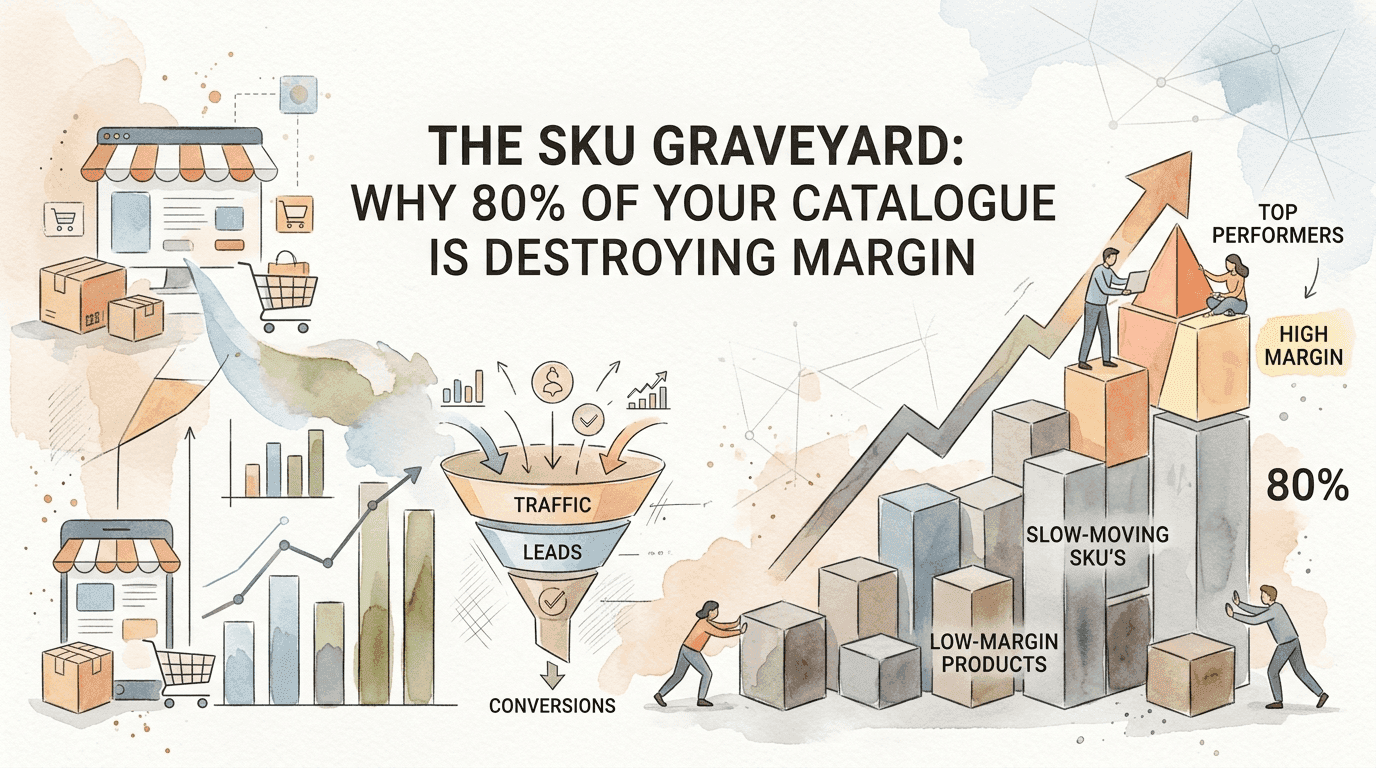
The SKU Graveyard: Why 80% of Your Catalogue Is Destroying Margin
Every ecommerce business carries a dirty secret buried in their product catalogue: zombies.
Product Profitability Analysis Template
Analyze product-level profitability to identify winners and losers in your product mix. Template for calculating margins, contribution, and strategic product decisions.
Return Rate Reduction Framework for Unit Economics
Reduce ecommerce return rates to protect profit margins. Framework for improving product presentation, sizing accuracy, and return policy optimization.
Return on Ad Spend (ROAS) Optimization Framework
Optimize return on ad spend across all marketing channels to maximize profitability and scale efficient growth. Framework for balancing ROAS targets with customer quality and lifetime value.

Why Your Financial Forecast Is Fiction (And How to Fix It)
# Why Your Financial Forecast Is Fiction (And How to Fix It) Every ecommerce business has a financial forecast. Most of them are wrong before the ink dries. The problem isn't that forecasters lack skill. It's that traditional forecasting treats an inherently uncertain future as if it were predict...
Shipping Cost Optimization: Unit Economics of Free Shipping
Optimize shipping costs while maintaining customer satisfaction. Framework for free shipping thresholds, carrier negotiation, and margin-safe delivery strategies.
Subscription Model Economics: The Recurring Revenue Mirage (And When Subscriptions Actually Create Value)
Subscription models have become the default recommendation for struggling ecommerce businesses. Revenue unpredictable? Add subscriptions. Customer acquisition costs too high? Convert to recurring revenue. Cash flow volatile?
The $29 Problem: Why Your CLV Model Is Bleeding Money (And the Cohort Economics Protocol to Fix It)
Your average CLV calculation is a fantasy. Learn the Cohort Economics Protocol that reveals which customers actually generate profit-and which ones you're paying to acquire.
The Unit Economics Command Centre: Building Your Profitability Dashboard
Most ecommerce dashboards track the wrong things.

Upsell and Cross-Sell Economics: Why Most Revenue "Lifts" Are Actually Margin Traps
Every ecommerce operator knows the standard talking points: upselling and cross-selling increase average order value, boost customer lifetime value, and generate additional revenue without additional acquisition cost. These claims are true.
Ready to put unit economics to work in your business?
Get a hands-on operator to turn these frameworks into results — book a free audit call.